Choosing care for your baby under one year old can feel overwhelming, especially when so many programs look similar from the outside. Many parents assume "infant care" is simply supervised time in a safe room, but this misses something profound: the earliest months of life are when the brain is most primed for emotional and relational learning. What happens in a quality early education setting during infancy shapes how your child learns to trust, explore, and connect for years to come. This guide will walk you through exactly what defines high-quality infant care, which daily practices matter most, and how to evaluate any program you're considering.
Table of Contents
- Understanding infant care in early education
- Core principles and daily practices
- Safety standards every parent should know
- The role of family engagement
- A fresh perspective: Choosing with confidence, not fear
- Explore nurturing early education programs
- Frequently asked questions
Key Takeaways
| Point | Details |
|---|---|
| Secure relationships matter | Consistent, responsive care supports emotional and developmental health in infants. |
| Play is foundational | Serve-and-return play-based interactions turn daily routines into rich learning experiences. |
| Safety first, always | Choose programs adhering to AAP/CDC and CPSC standards to ensure your child’s physical safety and well-being. |
| Family and program team up | Engaged families amplify the benefits of high-quality infant care programs. |
Understanding infant care in early education
The term "infant care" gets used loosely, but in early education settings it has a specific meaning. Infant care typically covers programs for children from birth through 12 to 36 months, with a primary emphasis on nurturing relationships, responsive caregiving, and safe environments that support both emotional safety and development. This is not glorified babysitting. It is a structured, intentional practice with measurable goals.
Most centers draw a clear line between "infant" and "toddler" care, because the developmental needs of a three-month-old look nothing like those of a 24-month-old. Infants are building their earliest emotional templates, literally learning whether the world is a safe and responsive place, while toddlers are beginning to test independence and language. Understanding this distinction helps you ask the right questions when touring programs.
The primary goals of quality infant care center on three things: emotional safety, relational care, and developmental health. Supervision matters, of course, but it is the foundation, not the ceiling. Programs that meet quality benchmarks, such as NAEYC accreditation, operate with defined standards for caregiver ratios, learning environments, and family communication that go far beyond basic oversight.
Quick comparison: infant vs. toddler care
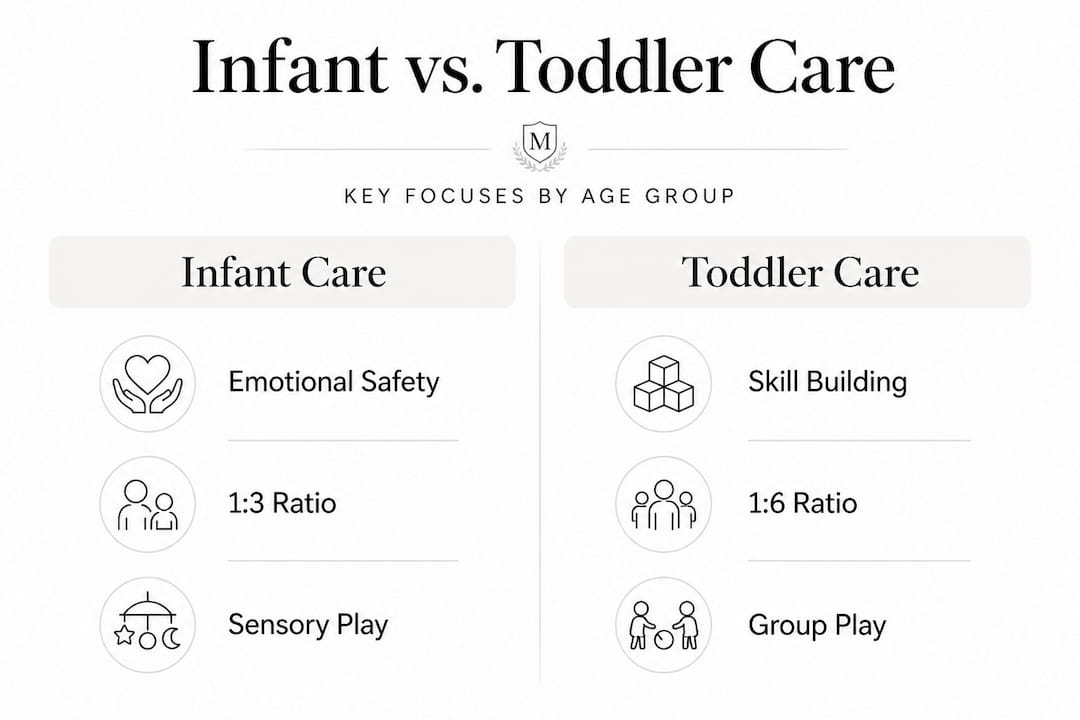
| Feature | Infant care (0 to 12 months) | Toddler care (12 to 36 months) |
|---|---|---|
| Primary focus | Emotional safety, attachment | Independence, language, mobility |
| Learning style | Sensory, relational, responsive | Play-based, exploratory, social |
| Caregiver ratio | 1:3 or lower | 1:4 typical |
| Daily rhythm | Individualized routines | More group-based structure |
| Communication | Nonverbal, serve-and-return | Emerging verbal and symbolic |
The emotional development in young children that begins in infancy forms the architecture for everything that follows, including school readiness, peer relationships, and self-regulation. Quality infant care is where that architecture starts to take shape.
Core principles and daily practices
Knowing what happens inside high-quality infant programs changes how you evaluate them. The core methodologies include primary caregiving, which means each infant is consistently assigned to the same caregiver, along with responsive individualized routines and play-based learning methods built around serve-and-return interactions and open-ended exploration.
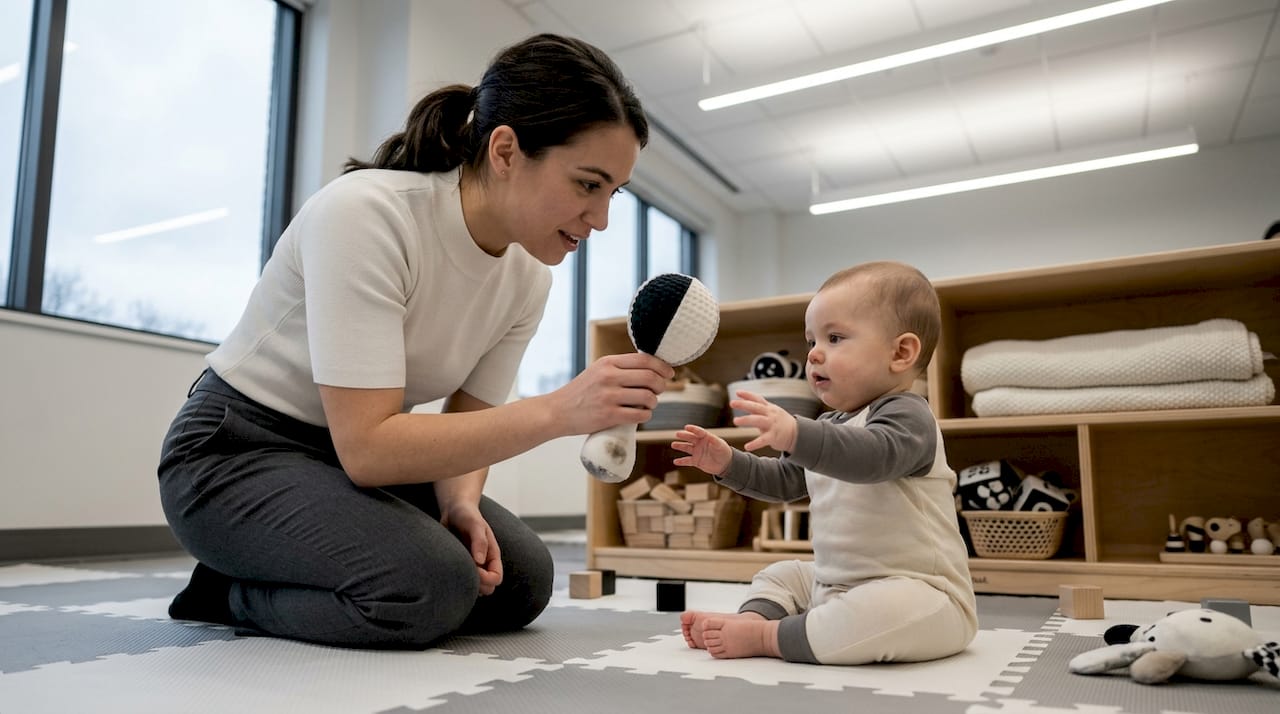
Primary caregiving is arguably the most important structural feature of a quality infant program. When your baby has one consistent adult who feeds, soothes, and responds to them day after day, it creates a secure attachment relationship outside the home. This is not simply comforting. It is neurologically significant. Infants whose needs are met consistently by familiar caregivers develop stronger self-regulation and stress-response systems.
Here is what individualized routine implementation looks like in practice:
- Feeding schedules are set by the infant, not the clock. A quality program tracks each baby's hunger cues and feeds on demand rather than enforcing group mealtimes.
- Sleep routines mirror what works at home. Caregivers learn each infant's sleep signals and create consistent pre-nap rituals that signal safety and predictability.
- Soothing strategies are documented and personalized. One baby may settle with gentle rocking, another with a specific song. Caregivers learn the language of each child.
- Transitions between activities are handled slowly, with narration and warmth, never rushed or abrupt.
Serve-and-return is a concept worth understanding deeply. It describes the back-and-forth interaction between a caregiver and an infant: the baby babbles, the adult responds with eye contact and a verbal reply, the baby smiles and kicks, the adult mirrors and narrates. The power of play in infant learning is rooted in these thousands of small exchanges that occur every day. They literally build neural connections.
"Responsive, emotionally present caregiving in the first year of life is not a luxury. It is the architecture of the developing brain."
Play in quality infant programs looks very different from toys left in a crib. It involves sensory-rich materials, floor time with varied textures and sounds, and, most importantly, a caregiver who actively participates and narrates. The educator becomes the most important learning tool in the room.
For emotional development tips during these early months, the research consistently points back to relational quality over any specific toy or curriculum.
Pro Tip: During any program tour, watch how staff interact when a baby fusses. Do they respond quickly, warmly, and with spoken narration? Or do they manage the situation from across the room? That moment tells you more than any brochure.
High-quality vs. basic program: comparison
| Practice | High-quality program | Basic program |
|---|---|---|
| Caregiver consistency | Same caregiver daily | Rotating staff |
| Response to crying | Immediate, warm, narrated | Functional, may be delayed |
| Feeding | On-demand, individualized | Scheduled, group-based |
| Play | Caregiver-engaged, sensory-rich | Toys provided, limited interaction |
| Family communication | Daily, detailed, two-way | Weekly or as-needed |
Safety standards every parent should know
Safety in infant care is not simply about locked gates and smoke detectors. It is a layered, standards-based practice that touches everything from how your baby sleeps to how the room smells. AAP and CDC safe sleep guidelines require that infants sleep on their backs, on a firm flat surface, with no soft bedding, bumpers, or positioning devices. Every single sleep, every single time.
CPSC-compliant cribs are mandatory in accredited programs. This means no drop-side cribs, no older equipment with slats spaced too wide, and no soft mattress toppers. The crib standard exists because safe childcare environments prevent the most serious infant injuries, many of which occur during sleep.
What to look for during a safety tour:
- Dedicated diapering areas that are fully separated from food preparation surfaces
- Visible handwashing stations accessible to caregivers at every transition
- Documented cleaning and disinfecting protocols for toys and surfaces
- Written safe sleep policy posted and followed consistently
- Emergency response plans posted and reviewed with all staff
- CPSC-compliant cribs with firm, properly fitted mattresses
- Age-appropriate toys with no small parts accessible to infants
- Secure entry systems that limit unannounced access
Hygiene is a major factor that many parents underestimate. Infants put everything in their mouths, and group care environments carry real infection risk. Programs that follow documented cleaning protocols, including specific disinfectants and frequency schedules, reduce illness rates significantly.
Pro Tip: Ask specifically about the program's response plan for respiratory illness outbreaks and their protocol for sick-child exclusion. A program that has clear, written answers to these questions is one that takes safety seriously at a structural level, not just a surface one.
For more on creating safe, nurturing learning environments, the principles that apply to preschool-age children extend all the way back to infancy. The standards are higher for infants, not lower.
The Martlet Academy blog also covers practical safety guidance for parents navigating these decisions across different program types and age ranges.
The role of family engagement
Here is something that surprises many parents: even in a high-quality infant program, your involvement as a family still shapes outcomes significantly. Research is clear that teacher beliefs and program structures predict care quality more reliably than the personal attachment styles of individual caregivers, and that family engagement can buffer or enhance the effects of out-of-home care.
In plain terms, this means two things. First, a well-structured program will serve your child better than one that relies on a single "star" teacher's personality. Second, what you do at home and how you partner with the program matters just as much as the care itself.
"Even the best care is most effective when supported by strong family engagement."
Here are three concrete ways to stay actively involved in your infant's early education:
- Daily communication rituals. Use whatever tool the program offers, whether that is an app, a daily sheet, or a face-to-face handoff conversation. Ask about mood, feeding, sleep, and one new thing you noticed at home. Share that information in both directions. Caregivers who know your baby's home context can provide better, more consistent care.
- Mirroring routines at home. When caregivers and parents use similar soothing techniques, sleep cues, and feeding rhythms, infants experience less stress during transitions. Ask your caregiver what is working and try to align your home approach with what the program uses, and vice versa.
- Thoughtful drop-off and pickup transitions. How you say goodbye and hello matters enormously to an infant's sense of security. A warm, predictable goodbye routine, even if brief, gives your baby the emotional signal that separation is safe and that you will return. Do not sneak out. Do not linger anxiously. Be warm, be brief, and be consistent.
Understanding how families shape learning from the very beginning helps you see yourself as a genuine partner in your child's care, not just a client of the program. Similarly, learning to support social emotional learning at home extends the work educators are doing every day into your family's daily routines.
A fresh perspective: Choosing with confidence, not fear
Most of the anxiety parents feel when choosing infant care comes from fear, fear of making the wrong choice, fear of missing something important, fear that no program will love their baby the way they do. That fear is understandable, but it can lead to poor decisions based on how polished a facility looks rather than how well it actually functions.
We have seen parents choose programs because the building is beautiful, only to discover that caregiver turnover is high and communication is inconsistent. We have seen parents overlook smaller, simpler centers that have extraordinary warmth, excellent ratios, and genuine NAEYC accreditation.
The most important thing you can assess in any infant program is relational quality. Watch the interactions. Watch how staff move through the room. Do they get down on the floor with babies? Do they talk to infants even when the infants cannot respond verbally? Do they seem genuinely delighted by the children in their care?
Accreditations and QRIS ratings matter, and you should absolutely factor them in. But your eyes during a tour tell you something that no certificate can. Observe how children learn best with play in the specific setting you are considering, and notice whether staff are active participants or passive supervisors.
What most parents miss is the compounding effect of consistent, warm, responsive care over months. It is not any single magical moment. It is thousands of small, attuned interactions that accumulate into secure attachment, language development, emotional regulation, and curiosity. You are not looking for a perfect program. You are looking for a consistently good one, staffed by people who genuinely see and respond to your baby.
Your own involvement adds a layer that no program can replicate. The families who feel most confident are not the ones who found the "best" program. They are the ones who found a good program and stayed actively engaged with it.
Explore nurturing early education programs
Finding care that genuinely aligns with these values takes time, but it is worth every question you ask and every tour you take.
At Martlet Academy, our programs are built on exactly the principles covered in this guide: emotional safety, individualized nurturing routines, play-based developmental support, and genuine partnership with families. Whether your child is approaching preschool age or you are planning ahead, our Preschool Program and Kinder Prep Program are designed with the same relational philosophy that begins in infant care and grows with your child. We would love to show you what a calm, curious, and connected learning environment looks like in practice. Connect with us to learn more and take the next step toward the right fit for your family.
Frequently asked questions
What age range does infant care in early education cover?
Infant care generally serves children from birth up to 12 months, with toddler programs typically covering 12 to 36 months, though some programs use a broader birth-to-36-month band.
Why are low child-to-caregiver ratios important in infant programs?
Low ratios of 1:3 to 1:4 ensure each infant receives individualized attention and builds a consistent, secure relationship with their caregiver, which is essential for healthy emotional and developmental outcomes.
How is play used as a learning tool for infants?
Responsive narration and sensory exploration during serve-and-return interactions turn everyday play into essential neurological learning, building language, emotional regulation, and curiosity from the earliest months.
What safety standards should all infant care environments follow?
Key standards include AAP and CDC safe sleep protocols, CPSC-compliant cribs, and full separation of diapering and food preparation areas to protect infant health and safety.
Can family involvement really make a difference if the care program is already high quality?
Yes. Family engagement buffers care effects and enhances outcomes even in top-rated programs, making your active involvement a meaningful contributor to your child's development regardless of program quality.