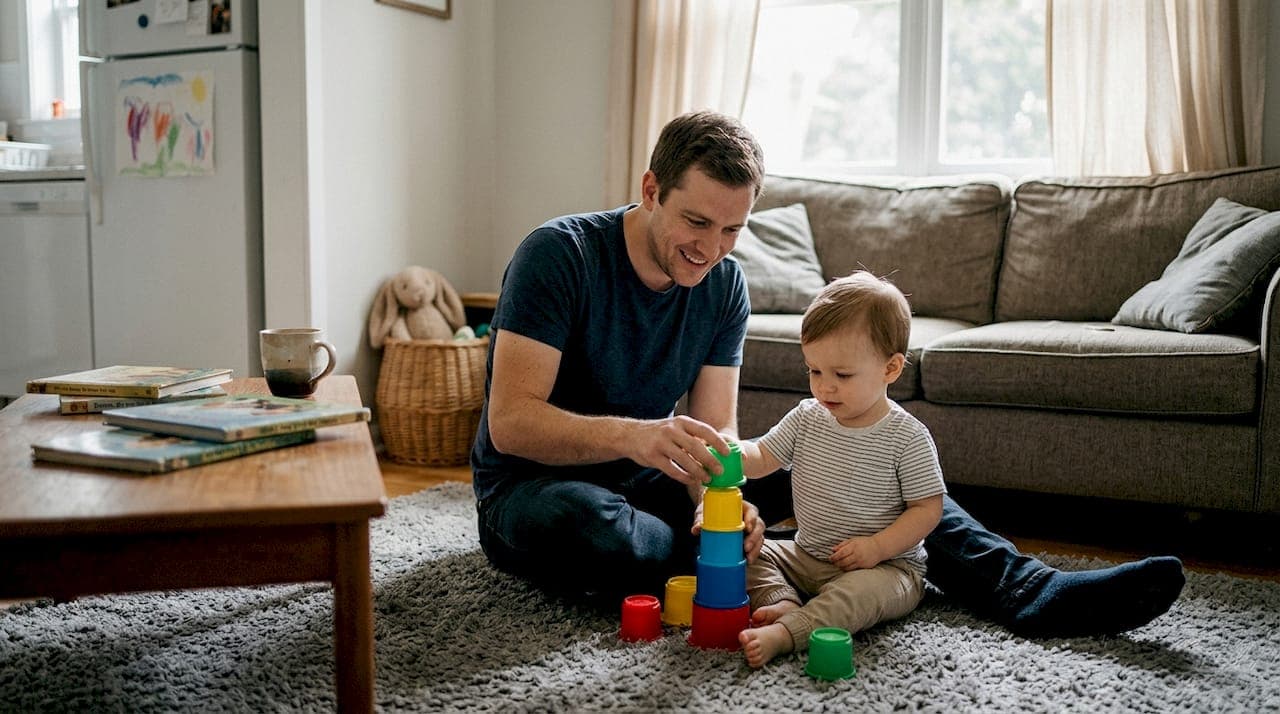
Every parent has been there: your toddler melts down at the grocery store, your infant won't stop crying despite everything you've tried, or your preschooler refuses to share with a friend. These moments feel overwhelming, but they are also opportunities. Social-emotional learning (SEL) is the process through which children learn to understand their feelings, build relationships, and make thoughtful choices. Research consistently shows that the emotional foundation you build at home in the first five years shapes how your child will connect with others, handle stress, and learn for the rest of their life. This guide gives you practical, science-backed strategies to support that growth every single day.
Table of Contents
- Understand the basics of social emotional learning
- Create a nurturing, responsive home environment
- Use everyday activities to teach emotions and social skills
- Promote positive peer interactions and social problem-solving
- How to monitor progress and support growth
- A parent's view: What really matters in supporting SEL
- Discover programs that nurture social-emotional growth
- Frequently asked questions
Key Takeaways
| Point | Details |
|---|---|
| Safe attachments are key | Building secure, loving relationships is the most powerful way to boost social and emotional skills in early childhood. |
| Everyday routines teach SEL | Simple activities like labeling emotions, playing, and reading together provide daily SEL practice for young children. |
| Peer play builds social skills | Facilitating guided play with others helps children learn sharing, empathy, and conflict resolution. |
| Track progress, seek help early | Monitoring age-based milestones and addressing concerns promptly ensures children get the support they need. |
| Balance warmth and structure | Combining love with consistent routines helps children feel safe, confident, and ready to learn. |
Understand the basics of social emotional learning
SEL stands for social-emotional learning, and it's not just a buzzword from the classroom. It's the set of skills that help your child know who they are, manage big feelings, relate to others, and make good decisions. Think of it as the emotional backbone that supports everything else your child does, from making a friend at the playground to sitting still long enough to hear a story.
The five core SEL skills are:
- Self-awareness: Recognizing one's own emotions and strengths
- Self-regulation: Managing feelings and impulses in healthy ways
- Social awareness: Understanding others' feelings and perspectives
- Relationship skills: Communicating, cooperating, and resolving conflict
- Responsible decision-making: Making thoughtful choices about behavior
The first five years of life are when the brain is most receptive to building these skills. Secure attachments foster self-regulation and resilience, and responsive caregiving during this window literally shapes how a child's stress response system develops. That's not pressure on you as a parent. It's encouragement. Your everyday interactions matter more than any curriculum.
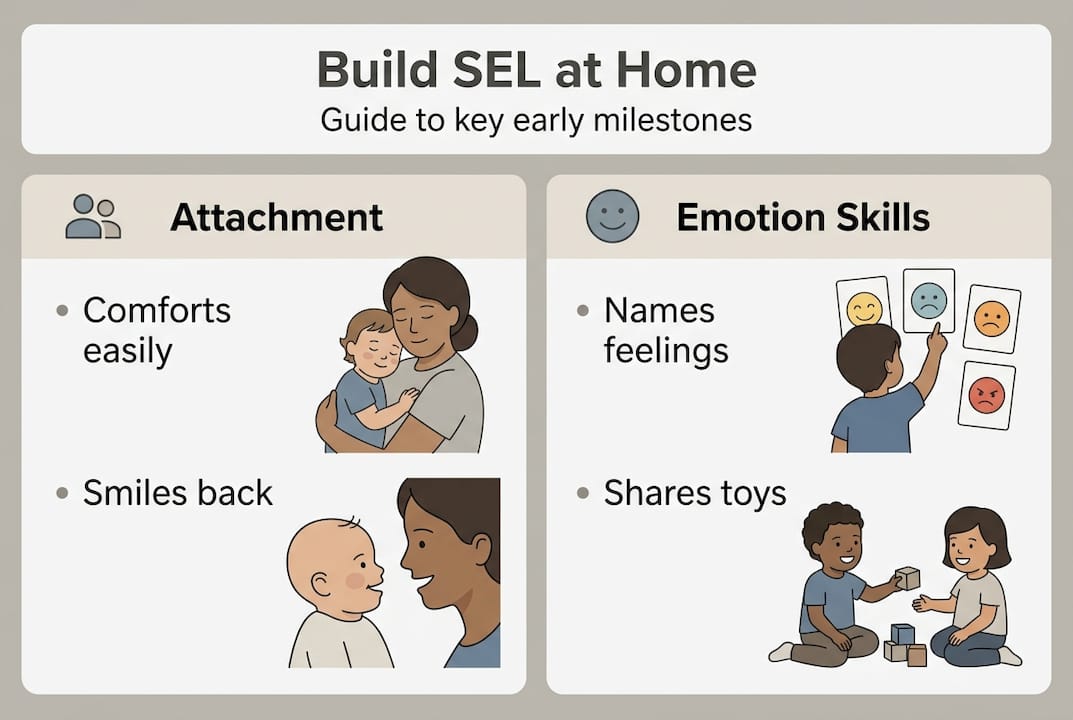
CDC SEL milestones show that by just 2 months old, babies calm when spoken to and smile responsively, which are early signs of emotional connection. The table below shows what typical SEL development looks like across the first few years.
| Age | SEL milestone examples |
|---|---|
| 2 months | Calms when spoken to, smiles at familiar faces |
| 6 months | Shows excitement, responds to emotions in others |
| 12 months | Shows affection, gets upset when caregiver leaves |
| 18 months | Shows empathy, plays near other children |
| 24 to 36 months | Takes turns, uses words for feelings, plays pretend |
Over 75% of children reach these milestones on time with consistent, loving care. When you understand these benchmarks, you can celebrate progress and notice early when your child might need a little extra support. Building lasting SEL skills starts with knowing what to look for and why it matters.
Once we understand why SEL matters, it's time to look at what you need before strengthening it at home.
Create a nurturing, responsive home environment
The single most powerful thing you can do for your child's SEL is to be consistently responsive. That means noticing what your child needs and meeting it with warmth, even when you're tired. Responsive, nurturing relationships provide secure attachments and support resilience in infants and toddlers, which sets the stage for every other skill.
Here's a quick comparison of how caregiving styles affect SEL outcomes:
| Caregiving style | Impact on SEL |
|---|---|
| Responsive and warm | Builds trust, emotional regulation, and confidence |
| Inconsistent or dismissive | Increases anxiety and difficulty managing emotions |
| Overly controlling | Limits independent decision-making and self-awareness |
| Balanced warmth and structure | Supports both security and healthy independence |
Daily routines are another anchor for emotional growth. Predictable schedules, like a consistent bedtime or a morning greeting ritual, help children feel safe. When children know what comes next, they can focus their energy on learning rather than worrying. You can read more about routine and structure in preschool and how it applies at home too.
Simple daily habits that build connection include:
- Making eye contact during feeding or diaper changes
- Using a calm, warm tone of voice during stressful moments
- Offering physical comfort like hugs and gentle touch
- Using positive language: "You're working so hard" instead of "Stop that"
- Narrating what you're doing so your child feels included
"Children need at least one stable, caring adult relationship to develop the resilience they need to thrive." This insight from developmental science underscores that you don't need to be perfect. You just need to be present and consistent.
Pro Tip: Use diaper changes, bath time, and car rides as mini SEL lessons. Simply naming feelings out loud, like saying "You seem frustrated right now, and that's okay," helps your child build an emotional vocabulary before they can even speak. Creating a nurturing learning environment at home mirrors what the best early childhood classrooms do every day. The sense of mattering that children gain from these small moments adds up to lasting emotional strength.
With the essentials in place, parents can take actionable steps that directly build specific SEL skills.
Use everyday activities to teach emotions and social skills
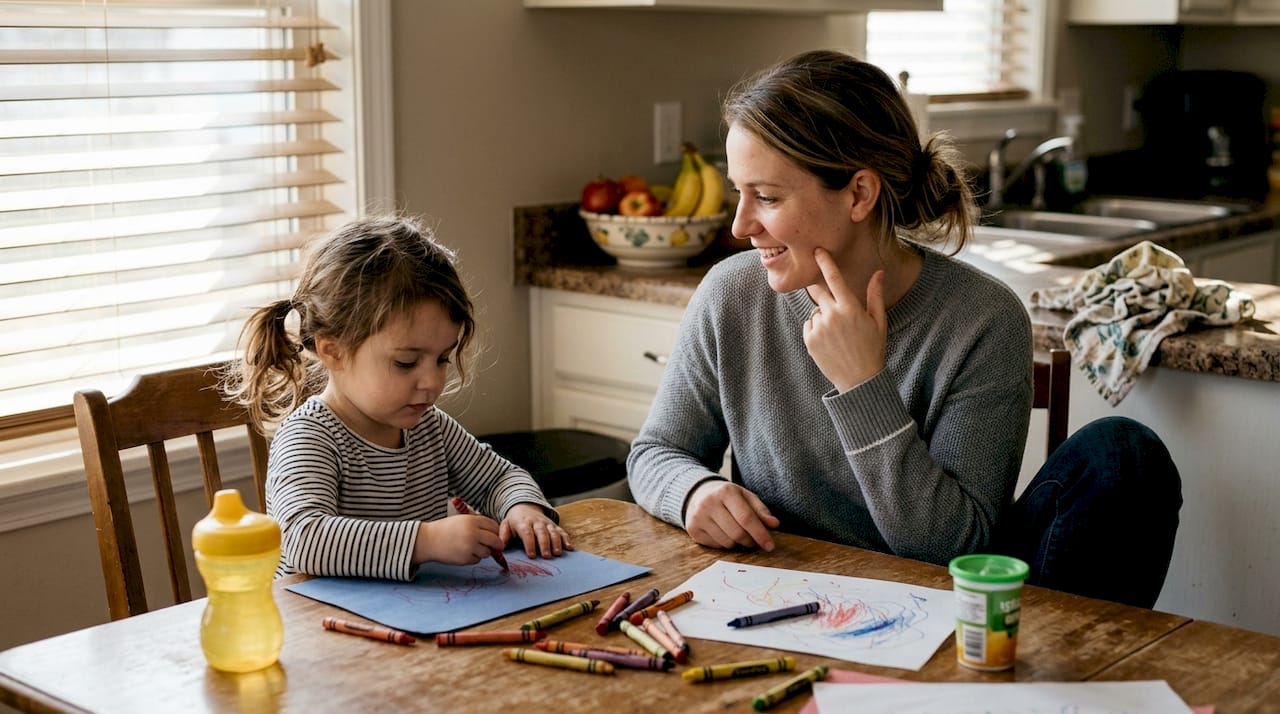
You don't need special toys or a structured curriculum to teach your child about emotions. The most effective tools are already in your home and your daily routine. Label and name emotions to help children identify and manage feelings, and use play, books, art, and mirrors as natural teaching moments.
Here are six go-to daily activities for building SEL:
- Feeling faces in the mirror: Sit with your child in front of a mirror and make happy, sad, surprised, and angry faces together. This builds emotional recognition in a playful, low-pressure way.
- Storytime with emotion check-ins: After reading a book, ask "How do you think that character felt?" This builds empathy and perspective-taking.
- Puppet and doll play: Use puppets to act out social scenarios like sharing a toy or saying sorry. Children often express and process emotions more freely through characters.
- Art and music for expression: Let your child paint or dance to music that matches different moods. Creative outlets give big feelings a healthy exit.
- Narrated play: As your child plays, describe what you see: "You're being so gentle with that baby doll." This reinforces prosocial behavior in real time.
- Simple decision-making moments: Offer choices throughout the day: "Do you want the red cup or the blue one?" Small decisions build the responsible decision-making skill.
Pro Tip: When your child shows a big emotion, try saying "You look frustrated. Do you want a hug or a break?" This validates the feeling and teaches them that they have options, which is the beginning of self-regulation. Connecting these activities to play-based learning helps children absorb SEL skills naturally, without it feeling like a lesson.
Now that your child is learning at home, supporting positive peer relationships becomes the next step.
Promote positive peer interactions and social problem-solving
Playdates and group play are where SEL gets tested in real time. Your child may grab a toy, refuse to share, or hide behind your leg when another child says hello. These are not failures. They are practice runs. Encourage peer interactions, pretend play, and sharing as stepping stones to prosocial behaviors rather than expecting them to happen automatically.
Here's how to handle common social struggles with calm, constructive responses:
- Not sharing: Instead of forcing it, try a timer. "You can have it for two more minutes, then it's your friend's turn." This teaches turn-taking without shame.
- Tantrums during play: Stay calm, get low to their level, and acknowledge the feeling before redirecting. "I see you're really upset. Let's take a breath together."
- Shyness with peers: Don't push. Stay nearby, narrate the other child's play, and let your child warm up at their own pace.
- Hitting or grabbing: Name the feeling and redirect: "You wanted that toy. We use our words. Let's try asking."
- Difficulty including others: Model inclusion yourself by inviting the quieter child into the activity and narrating what you're doing.
Modeling social cues is one of the most underrated strategies. When you narrate your own emotions, "I'm feeling a little overwhelmed right now, so I'm going to take a deep breath," you show your child exactly what SEL looks like in action. Connecting this to learning through play reinforces that social skills grow best in relaxed, child-led settings.
You'll also want to regularly check your child's progress and adjust as needed for their unique journey.
How to monitor progress and support growth
Tracking your child's SEL development doesn't require a formal assessment. It requires attention. Watch how your child handles frustration, connects with others, and recovers from upsets. These everyday observations tell you a lot about where they are and what they need next.
Typical SEL progress by age looks like this:
- By 12 months: Shows affection, seeks comfort from caregivers, reacts to others' emotions
- By 2 years: Plays alongside peers, shows empathy, uses a few feeling words
- By 3 years: Takes turns, negotiates in play, shows awareness of others' needs
- By 4 to 5 years: Resolves simple conflicts, expresses a range of emotions, shows self-control in structured settings
Watch for these signs that your child may need additional support:
- Persistent difficulty calming down after upsets, well beyond what's typical for their age
- Avoiding social interaction consistently, not just occasionally
- Significant regression in skills they had already developed
- Frequent and intense emotional outbursts that don't improve over time
- Trouble forming any attachment to familiar caregivers
CDC milestones benchmark SEL by age, and over 75% of children achieve them on track. If you have concerns, start by talking with your child's teacher or pediatrician. Early support makes a meaningful difference. As behavioral changes or delays are monitored closely, families who act early give their children the best chance to catch up and thrive. The lifelong learning outcomes tied to early SEL support are well-documented and significant.
Taking these steps allows you to adapt as your child's needs change. So what does this look like in the bigger picture?
A parent's view: What really matters in supporting SEL
Here's something we've learned from working with hundreds of families: the parents who feel like they're "not doing enough" for their child's SEL are often doing more than they realize. The most effective strategies are not the expensive ones. They are the consistent ones.
You don't need a feelings chart on every wall or a structured emotion lesson after dinner. What actually works is showing up the same way, day after day. Naming a feeling during a tantrum. Sitting with your child when they're upset instead of rushing to fix it. Offering warmth and structure in equal measure, because children need both to feel safe enough to grow.
One common mistake is expecting fast results. SEL builds slowly, like a muscle. Another is overcomplicating things. A book, a puppet, and five minutes of your full attention can do more than any app or program. The lasting impact of SEL comes from children feeling that they matter, not from any single activity. Trust the small moments. They add up.
Discover programs that nurture social-emotional growth
At Martlet Academy, everything we do is designed to support the same SEL skills you're building at home. Our educators use responsive, play-based approaches that mirror the strategies in this guide, so your child experiences consistency between home and school.
Whether you're looking for our infant program for your youngest child or our preschool program for a growing toddler, each is built around emotional safety, strong relationships, and age-appropriate learning. We partner closely with families to make sure every child feels seen, supported, and ready to grow. Visit Martlet Academy to explore our programs and take the next step toward giving your child a strong emotional foundation.
Frequently asked questions
What is an example of social-emotional learning for a toddler?
When a toddler learns to name their feelings and share toys with a friend during playtime, they are practicing social-emotional learning. Naming emotions and using play to practice social skills are two of the most foundational SEL strategies for this age group.
How can I help my child who struggles with sharing?
Encourage turn-taking with peers, narrate social cues, and praise efforts to share, even if the attempt is small. Peer interactions and pretend play are natural stepping stones toward more consistent sharing behaviors.
What are signs that my child needs more support with SEL?
Watch for ongoing trouble with calming down, making friends, or big changes in behavior, and seek professional advice if concerned. Behavioral changes or delays that persist over time are worth discussing with your child's pediatrician or teacher.
Can daily routines really impact my child's emotional growth?
Yes, consistent routines provide security and help children learn to manage their emotions and expectations. Consistent routines and rules give children a predictable framework that reduces anxiety and supports self-regulation.
How do I check if my child is meeting SEL milestones?
Review age-based milestones, use checklists or tracking apps, and compare your child's behaviors with CDC guidelines. CDC milestones benchmark SEL by age and can be tracked easily using their free milestone tracker tool.