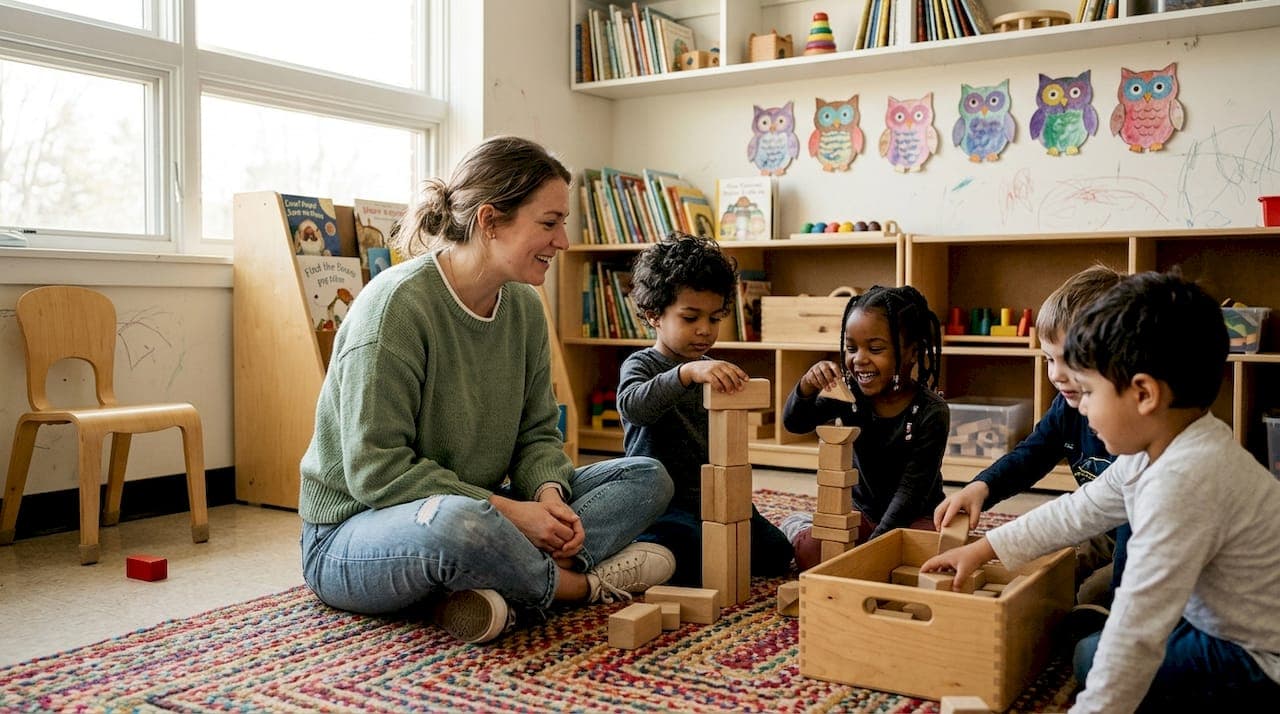
Many parents quietly worry that a classroom full of blocks, paint, and pretend kitchens means their child is falling behind. The opposite is true. Decades of research confirm that intentional, play-based learning builds stronger readers, better problem solvers, and more emotionally resilient kids than worksheets ever could. A major scoping review across 51 studies found moderate learning gains of roughly four months in literacy, numeracy, and language for children in play-based programs. This guide breaks down exactly what play-based learning is, which types matter most, how it shapes real development, and what you can do at home to keep the momentum going.
Table of Contents
- What is play-based learning?
- Core types of play-based learning in early childhood
- How play-based learning boosts child development
- Challenges, edge cases, and balancing with academics
- How families can support play-based learning at home
- Our perspective: What most guides miss about play-based learning
- Explore play-based learning at Martlet Academy
- Frequently asked questions
Key Takeaways
| Point | Details |
|---|---|
| Play powers learning | Intentional play activities drive lasting gains in academic and social-emotional growth. |
| Types of play matter | Guided and structured play boost skills more effectively than free play alone. |
| Family role is vital | Parent engagement at home enhances the benefits of play-based education. |
| Balance is key | Combining purposeful play with academics creates optimal learning for young children. |
What is play-based learning?
Play-based learning is an educational approach where children build knowledge, skills, and understanding through purposeful play experiences. It is not simply letting kids run loose. It is not traditional sit-and-repeat instruction either. It sits in a deliberate space between the two, where curiosity leads and educators guide.
Understanding how children learn best helps clarify why this approach is so effective. Young children's brains are wired for exploration. When a toddler stacks cups, she is not just having fun. She is testing gravity, sequencing, and cause and effect. Those are foundational math and science concepts forming naturally through play.
There are three primary forms this approach takes in early childhood classrooms:
- Free play: Completely child-directed. Children choose what to do, how to do it, and for how long. It builds autonomy and creativity.
- Guided play: An adult sets up the environment or poses questions to scaffold the child's exploration. This is the most researched and effective form.
- Structured games: Rule-based activities with clear learning objectives. Board games, sorting games, and cooperative activities fall here.
According to the National Childcare Authority, play types span free play, guided play, and structured games, each serving a distinct developmental role. The combination of all three is what makes a classroom truly rich.
One of the biggest misconceptions parents carry is that academic learning only happens when children are sitting quietly. In reality, a child negotiating the rules of a pretend restaurant is practicing language, math, and social reasoning simultaneously. A child finger-painting is building the fine motor control needed for writing.
"Play is the work of childhood." This idea, widely attributed to early childhood pioneer Jean Piaget, captures what research keeps confirming: play is not a break from learning. It is how learning happens at this age.
The key distinction is intention. A classroom where children roam aimlessly differs enormously from one where a trained educator designs play experiences with clear developmental goals in mind.
Core types of play-based learning in early childhood
Now that we have a basic understanding of what play-based learning is, let's examine the types your child might experience in a quality early childhood setting.
| Play type | Who leads | Example activity | Primary benefit |
|---|---|---|---|
| Free play | Child | Building a block tower | Creativity, autonomy |
| Guided play | Adult + child | Sorting colored beads with teacher prompts | Cognitive, math, spatial skills |
| Structured games | Adult-designed | Cooperative board game | Rules, turn-taking, numeracy |
Each type builds on the others. Here is a closer look at how each plays out in real classrooms:
- Free play gives children time to test their own theories. A child who repeatedly fills and dumps a container is working out volume. Teachers observe quietly, ready to ask a well-timed question that deepens the exploration without taking it over.
- Guided play is where intentional educators really shine. Research shows that guided play boosts math and spatial skills beyond what free play or direct instruction achieves alone. A teacher who sets up a nature table and asks, "Which leaf is widest?" is guiding scientific thinking without lecturing.
- Structured games introduce children to rules, fairness, and persistence. Concepts from gamification in education show how rule-based play motivates children and deepens engagement with academic content.
The role of teachers in each mode is different but equally important. In free play, they observe and document. In guided play, they scaffold. In structured games, they model and support.
Pro Tip: Ask your child's educator which blend of play types they use in a typical day. A classroom that only offers one mode may be missing key developmental windows. The richest environments move fluidly between all three.
Researchers agree that quality play-based programs, grounded in a lifelong learning foundation, set children up for lasting success well beyond kindergarten.
How play-based learning boosts child development
With the core types outlined, let's explore how they translate into real gains for your child across academic, cognitive, and social-emotional domains.
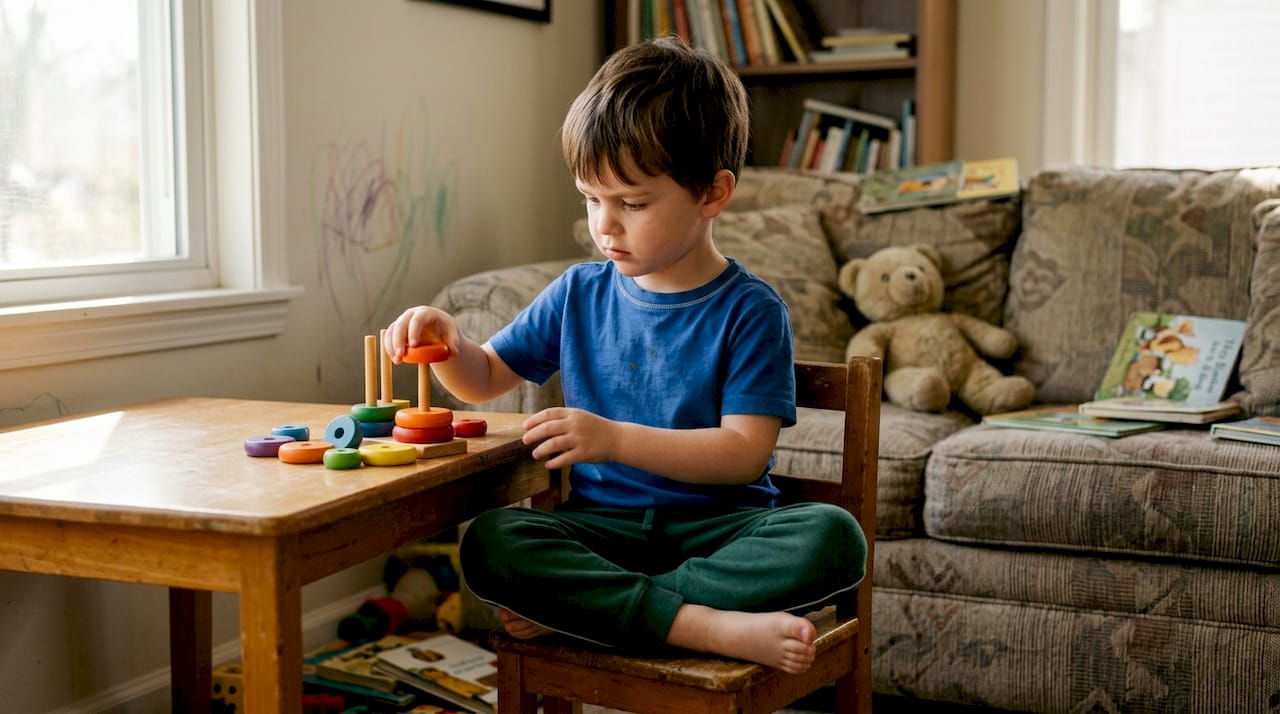
The numbers are compelling. A large-scale analysis found +4 months of learning in literacy, numeracy, and language outcomes for children in intentional play-based programs compared to peers in traditional instruction settings. That is not a small edge.
Academic gains:
- Early literacy: Story-based play builds vocabulary, narrative understanding, and phonological awareness.
- Numeracy: Sorting, building, and simple games introduce number sense and spatial reasoning.
- Language development: Dramatic play requires negotiation, explanation, and storytelling. These are sophisticated language tasks.
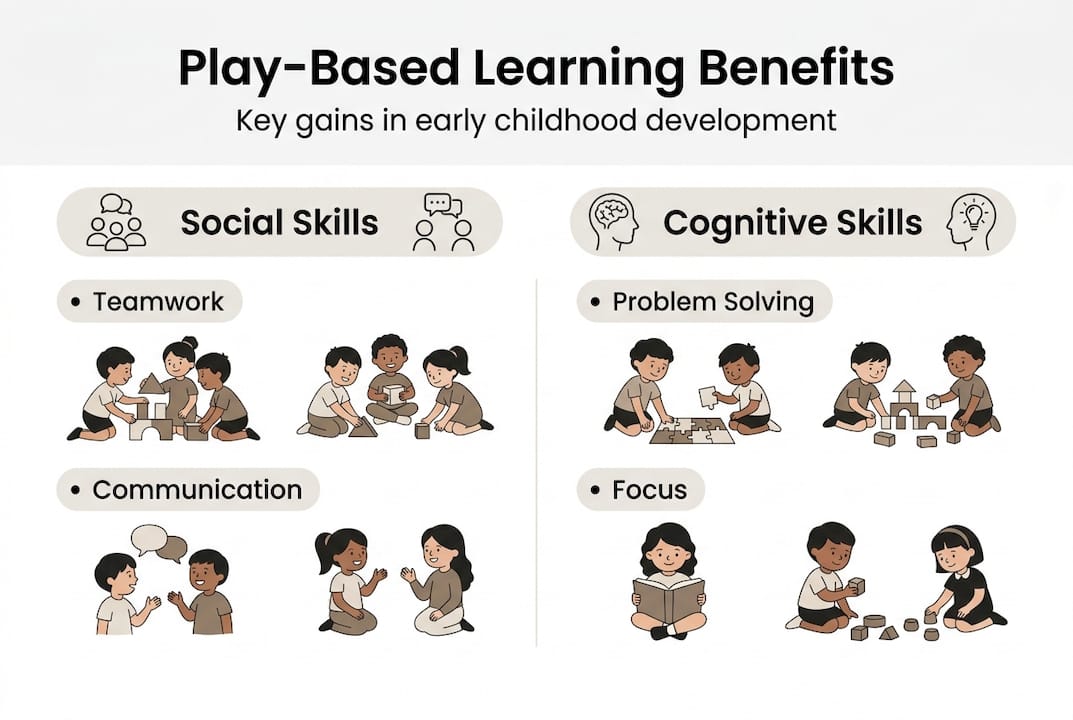
Social-emotional growth may be the most important benefit of all. Play teaches children how to manage frustration, take turns, read social cues, and recover from setbacks. These skills are what employers, teachers, and communities will ask of your child for the rest of their life.
Building social skills early through play gives children the emotional vocabulary to name feelings, the confidence to try new things, and the resilience to keep going after a hard moment. The connection between emotional intelligence in education and long-term life outcomes is well established.
Cognitive benefits include stronger executive function, the cluster of skills that includes focus, working memory, and flexible thinking. When a child plays a role in a story, she must hold the plot in mind, respond to other players, and adapt as the story changes. That is executive function training disguised as imagination.
All of this works best in nurturing environments where children feel emotionally safe. A child who feels anxious or unseen will not take the risks that drive deep play and learning. Emotional safety is not a soft extra. It is the foundation.
Challenges, edge cases, and balancing with academics
While the evidence is compelling, parents deserve a full picture, including possible challenges and how to ensure effective learning.
Play-based learning is not a magic fix that works under any condition. The research is clear that free play alone is weaker when it lacks intention, adult engagement, or clear developmental objectives. A child left to wander without any guided interaction may enjoy the freedom but miss critical learning moments.
Common challenges include:
- Resource constraints: Rural or underfunded programs often lack the materials and trained educators needed to run high-quality guided play.
- Academic pressure: As kindergarten expectations rise, some preschools shift toward worksheet-heavy instruction, squeezing out play time.
- Inconsistent implementation: A teacher who misunderstands guided play may hover too much, removing the child's autonomy, or step back too far, leaving exploration without direction.
- Parental skepticism: When parents expect to see desks, homework, and letter drills, they may misread a play-rich classroom as lacking rigor.
Balance matters enormously. Routine and structure are not enemies of play. They are partners. Children thrive when they know what to expect, which frees up mental energy for exploration and risk-taking within safe boundaries.
The best programs do not force a choice between play and academics. They weave learning objectives into every experience so that the child never feels the difference but always gains the skills.
Pro Tip: When visiting a prospective preschool, ask this specific question: "How do your educators set learning intentions before a play session?" The answer will tell you whether the program treats play as a filler or as a real instructional tool. A quality answer includes observation, documentation, and reflection. Knowing what to look for in a program makes a real difference in finding the right fit.
How families can support play-based learning at home
Beyond choosing a great preschool, you play a vital role in supporting your child's learning journey every single day.
Family engagement is not optional. Research shows that family involvement enhances social-emotional growth and strengthens the impact of play-based approaches in school. When home and school align, children get consistent signals that curiosity and exploration are valued.
Here are five concrete ways to bring play-based learning into your daily routine:
- Story-based play: Build on books your child loves. After reading, act out the story together or ask, "What would happen if the character made a different choice?"
- Pretend play setups: Create simple invitations to play, a tray of dried beans with measuring cups, a box of fabric scraps, or a set of toy animals near a bowl of water. Then follow your child's lead.
- Simple board games: Even games like Snakes and Ladders build counting, turn-taking, and emotional regulation when losing. Stay patient and model good sportsmanship.
- Narrate and question: While cooking or folding laundry, describe what you are doing and ask your child to predict what comes next. This builds language, sequencing, and logical thinking.
- Reflect together: After play, ask open-ended questions. "What was the hardest part?" or "What would you do differently?" Reflection turns experience into learning.
Strong communication strategies with your child's educators can help you connect what is happening at school to what you do at home.
Pro Tip: Family routines do not need to be long to count. Even ten minutes of open-ended play before dinner, where you sit nearby and follow your child's lead without directing, can reinforce the exploration mindset your child's preschool is building.
Our perspective: What most guides miss about play-based learning
After exploring the evidence and practical tips, let's step back and consider what matters most, based on lived classroom experience.
Most resources talk about play in a general way: "children learn through play" and "encourage open-ended exploration." That is true, but it misses the harder truth. The difference between transformative play-based learning and wasted time is adult intention and emotional attunement. We have watched children blossom not because their classroom had the right toys, but because their educator asked the right question at the right moment, and because their parents reinforced that same spirit of curiosity at home.
Family engagement cannot be outsourced to schools. The families who see the biggest breakthroughs are the ones who ask questions, show up with wonder, and treat play as worthy of their time and attention. Schools set the stage. Families sustain the story.
The concept of deliberate play for growth is at the heart of what we believe early childhood education should be. Not any play, not all play, but play with purpose, warmth, and a caring adult nearby.
Explore play-based learning at Martlet Academy
If you are ready to see what intentional, evidence-based play can do for your child, Martlet Academy is a natural next step.
Our preschool program is built on guided play, emotional safety, and family partnership, the same pillars this article has explored. From our Infant Program, which nurtures your youngest learner through sensory and relational play, to our Kinder Prep program, which builds confidence and school readiness, every experience at Martlet is purposeful. We invite you to visit, ask questions, and see for yourself how play and learning become one.
Frequently asked questions
How does play-based learning differ from traditional teaching?
Play-based learning centers around child-directed exploration and guided interaction, while traditional teaching typically relies on direct instruction, repetition, and worksheets. The child's curiosity leads in one approach; the curriculum script leads in the other.
What age group benefits most from play-based learning?
Infants, toddlers, and preschoolers gain the most because their brains are in a peak period of sensory and social development. Research confirms +4 months of outcomes in literacy and numeracy for young children in intentional play-based programs, building a foundation that supports learning for years.
Can play-based learning improve academic performance?
Yes. Studies confirm that guided play boosts math, spatial reasoning, language, and social-emotional skills beyond what direct instruction achieves on its own.
How can parents support play-based learning at home?
Encourage open-ended activities, ask reflective questions after play, and follow your child's lead. Family involvement enhances social-emotional growth and reinforces the habits a quality program builds every day.
What challenges do schools face in implementing play-based learning?
Resource limitations, rising academic pressure, and inconsistent educator training can all reduce quality. Intentionless play delivers weaker results, which is why skilled educators and supportive school policies are essential for real impact.
Recommended
- Play-Based Learning: How Children Learn Best in Preschool — Martlet Academy
- Why Early Childhood Education Shapes Lifelong Learning — Martlet Academy
- Blog — Martlet Academy
- Communication in early education: 5 strategies that work
- Interactieve leerhulpmiddelen: 66% meer woordenschat
- Benefits of bounce houses for kids: fun, fitness, growth