
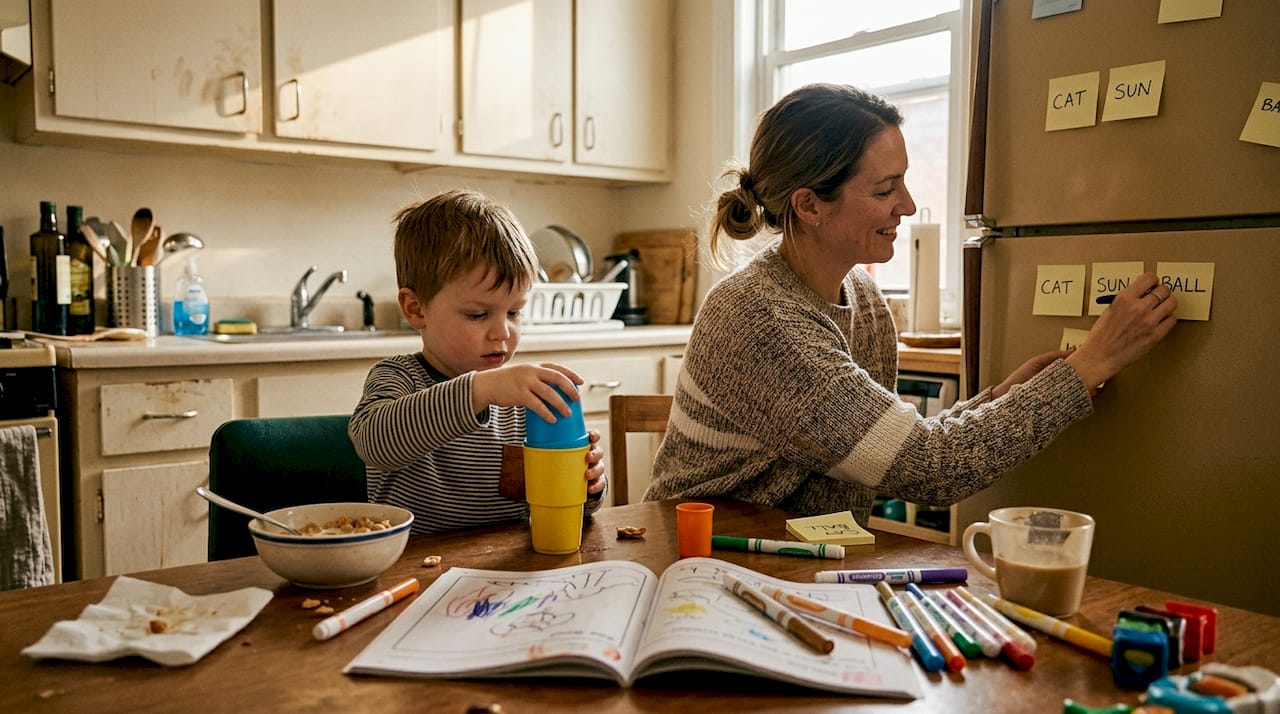
There's a quiet assumption many parents carry into their child's first years of school: that learning is mostly the teacher's job. Drop them off, trust the experts, and let the professionals do their work. But research tells a very different story. Family involvement in early childhood education significantly influences children's holistic development, including cognitive, social-emotional, and academic outcomes. What happens at home, at the dinner table, during bedtime stories, and in everyday routines shapes your child just as powerfully as anything that happens in a classroom.
Table of Contents
- Why family involvement matters in early learning
- Three dimensions of family involvement: What actually works?
- Frameworks and strategies: Turning research into action at home
- Recognizing barriers and bridging gaps: Real-world challenges
- Measuring impact and staying engaged: Making family involvement last
- A fresh take: Where families (not just schools) move the needle in early learning
- Support your child's early learning journey with expert guidance
- Frequently asked questions
Key Takeaways
| Point | Details |
|---|---|
| Family impact is foundational | Meaningful family engagement drives gains in children’s cognitive, emotional, and social development. |
| Diverse involvement works best | Combining home activities, school participation, and strong communication leads to optimal outcomes. |
| Address barriers early | Recognizing and supporting diverse family needs helps sustain strong early learning at home and beyond. |
| Track progress actively | Using benchmarks and regular self-checks lets families and educators ensure ongoing positive impact. |
Why family involvement matters in early learning
The years between birth and age five are unlike any other period in human development. The brain grows faster during this window than at any other point in life, forming connections at a staggering rate. What children experience during these years, including who talks to them, how they're comforted, and what they're encouraged to explore, lays the groundwork for everything that follows. This is why the lifelong benefits of early learning are so well documented across decades of research.
Family engagement is not just a nice-to-have. It is foundational. Holistic child development spanning cognitive, social-emotional, and academic growth is directly shaped by how involved families are in early learning. Children whose families read to them regularly, use rich vocabulary in conversation, and establish predictable routines show stronger language skills, better emotional regulation, and more confidence in social settings.
"The home environment is not a supplement to early education. For children ages 0-5, it is often the primary classroom."
Here's what family involvement actually looks like in practice during the early years:
- Language exposure: Talking, narrating daily activities, and reading aloud build vocabulary and listening comprehension.
- Emotional regulation support: Naming feelings and modeling calm responses teaches children how to manage their own emotions.
- Routine and structure: Predictable schedules help children feel safe and ready to learn.
- Play engagement: Joining your child in imaginative or physical play deepens attachment and supports cognitive growth.
- Teacher communication: Staying in regular contact with educators ensures consistency between home and school.
High family involvement correlates with improved academic performance and socioemotional skills, and these effects are measurable as early as preschool. Families who understand this early have a genuine advantage, not because they push harder, but because they show up consistently.
Three dimensions of family involvement: What actually works?
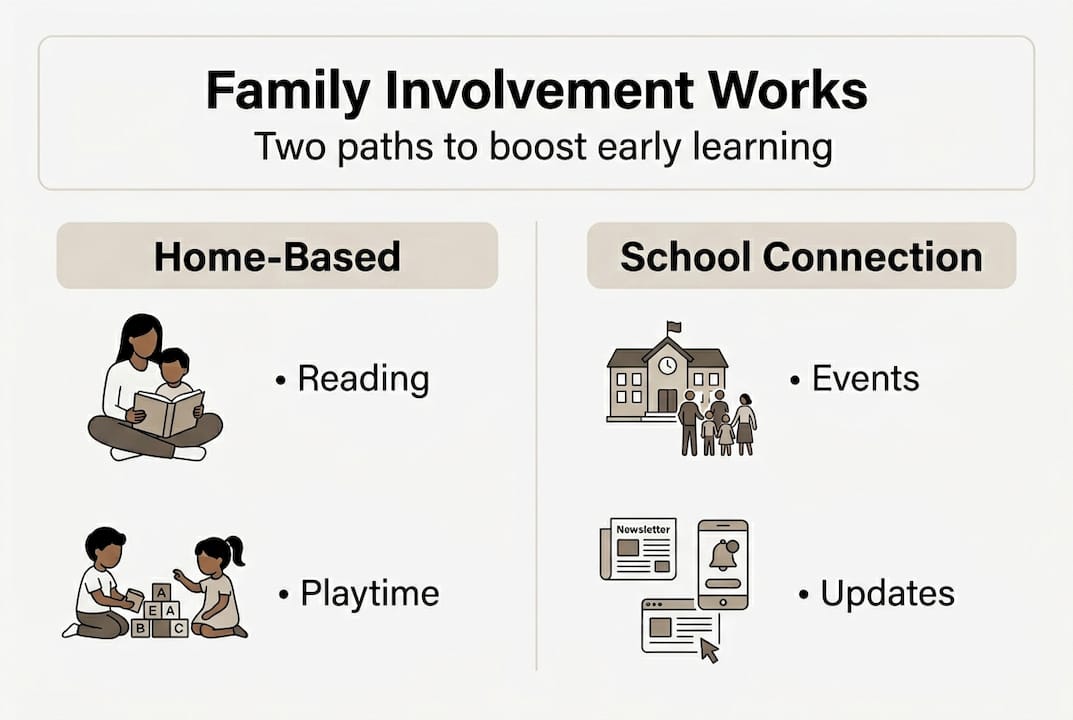
Not all family involvement looks the same, and that's actually good news. You don't have to volunteer at school every week or attend every event to make a meaningful difference. Research identifies three core dimensions of family involvement: home-based activities, school-based participation, and home-school communication. Each one contributes something unique.
| Dimension | Typical activities | Key benefits |
|---|---|---|
| Home-based | Reading, play, routines, learning games | Language growth, emotional security, cognitive development |
| School-based | Volunteering, attending events, classroom visits | Child sees family value education; builds community |
| Home-school communication | Progress updates, teacher check-ins, goal sharing | Consistency, early problem detection, aligned expectations |
Think of these three dimensions as legs of a stool. Remove one, and the whole thing wobbles. A family that reads every night but never talks to the teacher may miss early signs of a challenge. A family that volunteers often but doesn't reinforce learning at home may find the school's efforts don't stick.
Here's how to strengthen each dimension intentionally:
- Home-based: Set aside 15 to 20 minutes daily for a shared activity, whether reading, puzzles, or sensory play. Rotate activities to keep it fresh.
- School-based: Attend at least one classroom event per term. Even a single visit shows your child that school matters to you.
- Home-school communication: Ask your child's teacher for a simple weekly update, even a brief note or message. Share what you're noticing at home too.
Pro Tip: When school and home routines align, children experience less anxiety and transition more smoothly between environments. Ask your child's teacher what the classroom schedule looks like, and mirror key elements at home. You can find more ideas in resources about nurturing learning environments and the importance of routine in preschool.
Frameworks and strategies: Turning research into action at home
Understanding the theory is only half the battle. The real difference comes from what families do day to day. One of the most respected frameworks for family engagement in early childhood is the Head Start Parent, Family, and Community Engagement (PFCE) framework. It outlines goal-oriented family partnerships, cultural and linguistic responsiveness, and program elements that connect families to children's learning in meaningful ways.
What makes this framework stand out is its strengths-based approach. Instead of focusing on what families lack, it builds on what they already bring: their language, their culture, their stories, and their routines. Strengths-based family practices including two-way communication, home visits, shared reading, and multi-sensory play are among the most effective tools for aligning home and school learning.
| PFCE framework element | Practical home action |
|---|---|
| Family partnerships | Set a monthly learning goal with your child's teacher |
| Cultural responsiveness | Use your home language in storytelling and songs |
| Teaching and learning | Incorporate play-based learning strategies into daily play |
| Community connections | Join parent groups or library story times |
| Family well-being | Prioritize your own rest and mental health as a caregiver |
Here are practical steps any family can start this week:
- Shared reading: Read together for at least 10 minutes daily. Ask open-ended questions like "What do you think happens next?"
- Multi-sensory play: Use water, sand, playdough, or building blocks to engage multiple senses at once.
- Goal setting with teachers: At your next check-in, ask your child's teacher about development milestones and set one shared goal for the month.
- Cultural storytelling: Share family stories, songs, or traditions in your home language. This builds identity and language skills simultaneously.
Pro Tip: You don't need to buy expensive educational toys. A cardboard box, a spoon, and some dried pasta can become a drum kit, a building project, or a counting game. The richness comes from your engagement, not the materials.
Recognizing barriers and bridging gaps: Real-world challenges
Even with the best intentions, families may run into real challenges, some visible, some hidden. Socioeconomic status, parental education level, and mental health all play a role in how families are able to engage. Family characteristics like parental education, access to health insurance, and household stability directly correlate with better childcare choices and child growth outcomes.
This isn't about blame. It's about understanding the full picture so we can find real solutions. Common barriers include:
- Time constraints: Long work hours leave little energy for structured home learning.
- Language differences: Families who speak a language other than English may feel less confident communicating with teachers.
- Mental health challenges: Parental stress and anxiety can limit emotional availability, which affects a child's sense of security.
- Mismatched expectations: When parents and teachers have different ideas about what a child needs, parent-teacher perception gaps can quietly harm a child's social and cognitive development.
"Interventions work best when they address both the child and the family together. Focusing only on the child, without supporting the family system, limits long-term impact."
Effective early childhood interventions are most successful when they are family-centered, not just child-centered. Screen time, for example, is a poor substitute for real interaction, even when the content is educational. Face-to-face engagement, back-and-forth conversation, and shared physical play cannot be replicated by a screen.
If you're navigating barriers, start small. A brief daily conversation with your child about their day, a consistent bedtime routine, or a single monthly meeting with their teacher can shift the dynamic meaningfully. Looking for a quality preschool program that actively supports family involvement can also make a significant difference, especially in settings with small class sizes where teachers have more time to partner with you.
Measuring impact and staying engaged: Making family involvement last
Once families start making changes, it's essential to know how to assess progress and keep momentum going. One practical tool is the Family Involvement Questionnaire, a standardized instrument that helps families and educators track engagement across home-based, school-based, and communication dimensions. Monitoring family engagement through tools like this connects directly to improved academic performance and socioemotional skills in children.
Beyond formal tools, families can track their own progress with simple self-checks. Ask yourself: Is my child talking more? Are they showing more confidence in new situations? Are they sleeping and eating well? These everyday signs often reflect the quality of family engagement more accurately than any test score.
Steps to sustain family involvement year-round:
- Schedule a monthly family check-in to review what's working and what needs adjusting.
- Keep a simple journal of activities you do together and any changes you notice in your child.
- Stay connected with your child's teacher each term, even when things seem to be going well.
- Celebrate small wins. A new word, a new friend, a brave moment all count.
- Revisit your goals each season, since children grow fast and what worked at age two may need updating by age four.
Research also shows that family intimacy and resilience are positively associated with children's social-emotional competence, and this relationship is strengthened when families and preschools work together consistently. The payoff extends well beyond the early years. Families who stay engaged during ages 0-5 set a pattern that supports kindergarten readiness and long-term school success. You can find ongoing family involvement tips and resources to keep building on what you start today.
A fresh take: Where families (not just schools) move the needle in early learning
After stepping through the evidence and strategies, it's worth pausing to consider what most people, and even some educators, still get wrong. There's a persistent belief that more preschool hours automatically equal more learning. But the quality of what happens at home often matters more than the quantity of time spent in a classroom.
Schools are remarkable, but they cannot replicate what a family provides: the emotional safety of a known face, the repetition of a family joke, the comfort of a consistent bedtime ritual. These are not soft extras. They are the scaffolding on which all other learning is built.
We've seen families who felt they had "nothing to offer" because they didn't speak English confidently or hadn't finished school themselves. And yet their children thrived, because those families showed up emotionally, told stories in their home language, and made their children feel seen. That is irreplaceable. Teacher-family partnerships work best when teachers recognize and amplify what families already bring, rather than asking families to become something they're not. The most effective involvement is the kind that fits your life, not a program designed for someone else's.
Support your child's early learning journey with expert guidance
For families ready to move from ideas to action, supportive programs can amplify your efforts. At Martlet Academy, we've built every program around one core belief: children thrive when families and educators work as true partners.
Whether your child is just starting out in our Infant Program, finding their footing in our Toddler Program, or growing in our Preschool Program, you'll find a team that communicates openly, welcomes your input, and designs learning experiences that extend naturally into your home. We'd love to show you what that looks like in person. Reach out today to schedule a tour and take the next step together.
Frequently asked questions
How much time should families spend on early learning at home?
Even 10 to 20 minutes of focused daily interaction can make a measurable difference. Family involvement at any level significantly shapes children's cognitive and social-emotional development.
What if our family can't volunteer at school—does it still count?
Absolutely. Home-based involvement like reading together, having conversations, and sharing routines with teachers is just as impactful as in-person school participation.
How can families and teachers align their expectations for a child's learning?
Regular, open communication is key. Perception differences between parents and teachers can quietly affect a child's development, so sharing goals and progress often prevents misunderstandings before they grow.
Are screen-based early education programs as effective as real family interaction?
No. Screen time is a poor substitute for face-to-face play and conversation, especially for children under five, where back-and-forth interaction drives the most growth.
How do I measure if our family involvement is working?
Watch for signs like new vocabulary, improved social confidence, and positive teacher feedback. Standardized tools like the Family Involvement Questionnaire can also help you track engagement more formally over time.
Recommended
- Why Early Childhood Education Shapes Lifelong Learning — Martlet Academy
- The Role of Teachers in Early Childhood Development — Martlet Academy
- Creating a Safe and Nurturing Preschool Learning Environment — Martlet Academy
- Blog — Martlet Academy
- Guide to preschool learning at home for East London families