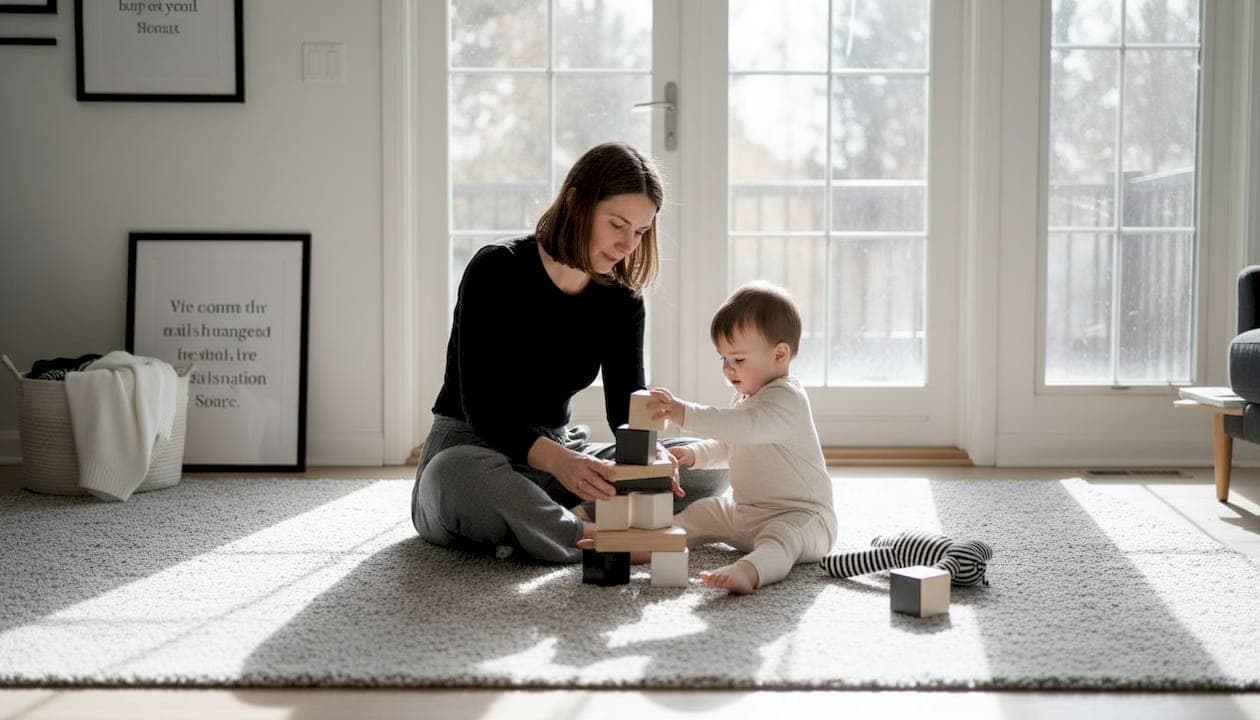
Picture a seven-month-old stretching her whole body toward a colorful rattle just out of reach. Her fingers spread wide, her shoulder lifts, and her core tightens. That single moment of effort is doing more for her brain and body than most parents realize. Every reaching attempt, every crawl toward a toy, every pinch of a soft block is quietly building the physical and cognitive foundation she will use for the rest of her life. This guide gives you practical, evidence-backed strategies you can start today, no special equipment required.
Table of Contents
- Understanding motor skills and developmental milestones
- Preparing your environment for active play
- Step-by-step strategies to build motor skills
- Tracking progress, troubleshooting, and acting early
- The extra value of structured interventions
- What most guides miss about real-world motor skills encouragement
- Connect with supportive learning programs for motor skill development
- Frequently asked questions
Key Takeaways
| Point | Details |
|---|---|
| Frequent play matters | Short, regular and responsive motor skill exercises accelerate progress without overwhelming the child. |
| Match activities to milestones | Tailoring play-based routines to your child’s age supports optimal skill development and identifies areas for help. |
| Structured programs add value | Evidence shows systematic approaches improve not only motor skills but also executive functions in young children. |
| Stay responsive | Effective encouragement means balancing challenge with support and intervening early when progress stalls. |
| Safe environment is essential | Supervised play and careful tool selection reduce risk and foster healthy motor skill growth. |
Understanding motor skills and developmental milestones
Before diving into activities, it helps to know exactly what you are building. Motor skills in early childhood fall into two broad categories, and understanding the difference helps you choose the right activities at the right time.
Gross motor skills involve large muscle groups and whole-body movements. Rolling, sitting, crawling, standing, and eventually running and jumping all fall here. Fine motor skills involve the small muscles of the hands and fingers, covering actions like grasping, pinching, stacking, and eventually writing.
Here is a quick look at typical milestone windows across the infant and toddler years:
| Age range | Gross motor milestone | Fine motor milestone |
|---|---|---|
| 2 to 4 months | Holds head steady; pushes up on forearms | Brings hands together at midline |
| 4 to 6 months | Rolls front to back; sits with support | Reaches and grasps objects |
| 6 to 9 months | Sits without support; begins crawling | Transfers objects hand to hand |
| 9 to 12 months | Pulls to stand; cruises along furniture | Uses pincer grasp (thumb and finger) |
| 12 to 18 months | Walks independently; squats and stands | Stacks 2 to 3 blocks; scribbles |
| 18 to 24 months | Runs; kicks a ball | Turns pages; uses a spoon |
| 2 to 3 years | Jumps; climbs low stairs | Draws basic shapes; snips with scissors |
The CDC's Learn the Signs, Act Early guidance encourages caregivers to match activities to age-typical milestones and to see themselves as a child's "first teacher." That framing is worth embracing fully. You are not waiting for development to happen on its own. You are actively shaping it.
Healthcare providers, as the Cleveland Clinic explains, use gross motor milestones to decide when to evaluate for possible delays, especially when a child's goal-directed movement, like reaching and crawling toward toys, is noticeably behind the curve. Knowing what is typical keeps you informed and calm.
The preschool milestone guide at Martlet Academy's blog offers a deeper look at what to expect as children move through ages three to five, which is where motor skill complexity grows quickly.
Key things to watch across all age ranges:
- Is the child attempting new movements, even imperfectly?
- Are both sides of the body developing evenly?
- Is the child gaining rather than losing skills?
- Does the child show curiosity about physical exploration?
Preparing your environment for active play
A safe, well-prepared space does most of the work for you. Young children are naturally motivated to move. Your job is to remove barriers and add invitations.
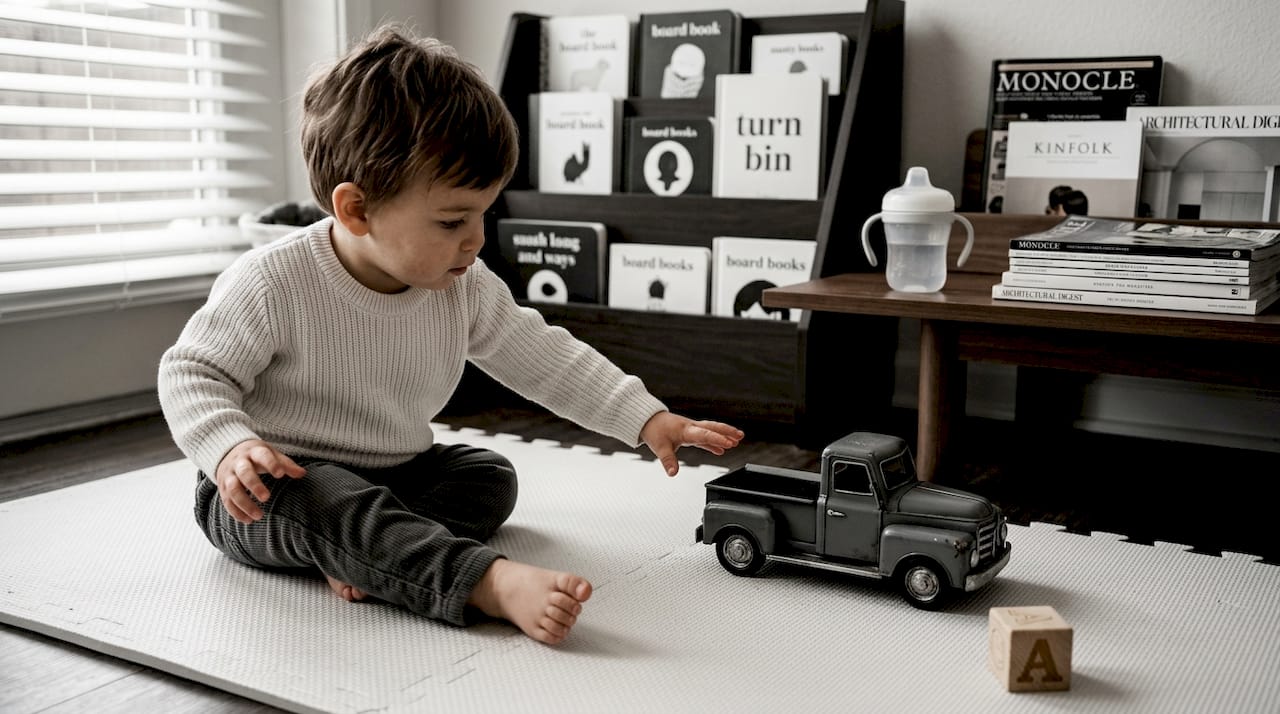
The AAP HealthyChildren resource emphasizes frequent, responsive movement play for babies, including supervised tummy time and floor play, as the evidence-backed approach to supporting early motor development. "Frequent" and "responsive" are the two words worth holding onto.
Here is a comparison of play environments that either support or limit motor skill practice:
| Environment feature | Supports motor growth | Limits motor growth |
|---|---|---|
| Floor space | Clear, padded area for rolling and crawling | Mostly confined to bouncer or swing |
| Toy placement | Just out of reach to encourage movement | Always handed directly to the child |
| Surfaces | Firm and varied (carpet, mat, bare floor) | Only soft surfaces that restrict movement |
| Supervision | Active, engaged presence nearby | Absent or distracted |
| Session length | Short bursts, repeated often | Long, infrequent sessions |
Pro Tip: Think of tummy time as a daily "dose" rather than a single activity. Three to five minutes, four to six times a day, is far more effective than one twenty-minute session. Short, repeated exposure builds strength gradually without overwhelming a young baby.
For play-based motor skill activities that fit into a busy family routine, you do not need to buy expensive toys. Firm cushions to climb over, scarves to pull, cardboard tubes to roll, and containers to fill and dump are all excellent tools for gross and fine motor practice.
A few practical setup tips:
- Use a firm play mat on the floor rather than always placing babies in an elevated seat
- Place interesting toys slightly beyond reach to encourage purposeful movement
- Rotate toys regularly so novelty keeps motivation high
- Ensure the space is free of sharp edges, cords, and choking hazards before beginning any session
- Stay within arm's reach during all floor play with infants
The principle of play-based learning for preschoolers carries directly into motor skill work: children learn fastest when they are intrinsically motivated and emotionally safe.
Step-by-step strategies to build motor skills
Now the practical part. These routines work because they are short, repeatable, and matched to what children can actually do at each stage.
For gross motor skills (whole-body movement):
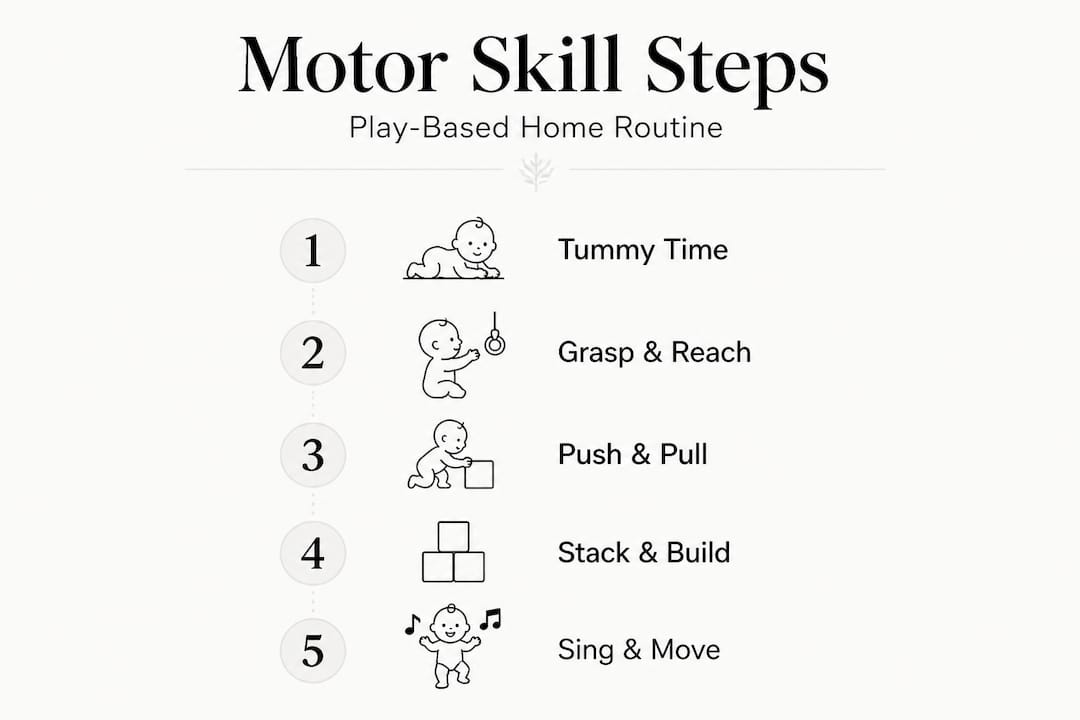
- Start tummy time from the first week of life. Place your baby on your chest initially, then move to a firm floor mat. Gradually increase duration as the baby gains neck strength.
- Position toys just outside grasp during tummy time to encourage reaching, which strengthens the core and shoulders simultaneously.
- As your baby nears six months, practice supported sitting by placing them between your legs on the floor. Let them experience balance without full support.
- Once crawling begins, create simple obstacle courses using rolled-up blankets or low pillows to encourage problem-solving through movement.
- For toddlers, add climbing opportunities, low steps, gentle slopes, and sturdy furniture to pull up on. Encourage kicking, throwing, and catching soft balls.
For fine motor skills (hand and finger control):
- Offer large, graspable objects in the first three months. Soft rings and textured balls encourage the reflexive grasp and build toward voluntary control.
- Between four and six months, dangle items at midline to encourage two-handed reaching and hand-to-hand transfer.
- From eight months onward, place small (but safe and non-chokeable) objects on a tray and encourage picking up and releasing. The Raising Children Network recommends quiet, low-pressure, tool-based play that practices finger control while keeping safety at the center.
- For toddlers, introduce stacking cups, simple puzzles, tearing paper, and using a spoon at mealtime.
- For preschoolers, add threading beads on a thick cord, using child-safe scissors, and drawing with chunky crayons.
The CDC's caregiver guidance is clear: matching activities to age-typical milestones is the most reliable way to support development without pushing ahead of what is developmentally appropriate.
Pro Tip: Sing finger songs like "Itsy Bitsy Spider" or "Where is Thumbpkin?" during fine motor sessions. The rhythm keeps children engaged longer, and the hand movements themselves are excellent finger-isolation exercises.
A helpful parallel: just as play-based learning impact reaches beyond academics into self-regulation and curiosity, motor skill practice builds not just strength but confidence. Children who can move their bodies well tend to feel capable in other areas too. The overlap with social-emotional skill examples is real and well-documented.
Tracking progress, troubleshooting, and acting early
Even with a solid routine in place, tracking what you observe keeps you grounded in your child's actual progress rather than assumptions.
Practical tracking tools include:
- A short video taken weekly to compare movement quality over time
- A simple journal entry after each play session noting what the child attempted and what succeeded
- A printed milestone checklist checked monthly, matched to the child's age
- Notes from childcare providers or family members who observe the child in different settings
"When a child is not meeting milestones, or has lost skills they previously had, act early. Talk to the child's doctor and request a developmental screening rather than waiting to see if things improve." CDC Learn the Signs, Act Early
That guidance is firm for a reason. Early intervention, when it is needed, produces significantly better outcomes than delayed action. Waiting is the one thing that consistently works against a child.
Common pitfalls that slow motor skill progress:
- Under-challenging: Always handing toys directly to a child removes the crucial motivation to reach and problem-solve through movement.
- Over-pressuring: Drilling a skill or showing frustration when a child cannot perform a movement creates anxiety that shuts down exploration.
- Inconsistency: Sporadic play sessions are far less effective than short daily routines. The AAP guidance consistently points to frequency and responsiveness as the two most important variables.
- Skipping tummy time: This is the single most common missed opportunity in the first year. Tummy time builds the core and shoulder strength that makes crawling and eventually walking possible.
Red flags that warrant a conversation with your pediatrician include: not meeting milestones within the typical age window, losing skills that were previously established, a strong preference for using only one hand before 18 months, or a noticeable asymmetry in how the body moves. The Cleveland Clinic's overview of gross motor development offers a thorough picture of what providers look for when evaluating movement concerns.
For a deeper look at early motor skills and development and what the research says about intervention timing, the Martlet Academy blog covers the science in parent-friendly language alongside practical preschool milestones guidance.
The extra value of structured interventions
Spontaneous play is essential. But structured motor skill programs add a layer of benefit that everyday play alone rarely delivers.
Research published in Scientific Reports found that structured fundamental motor skill interventions improve outcomes that go well beyond physical ability, including gains in executive function skills like focus, planning, and self-regulation. These are the exact skills children need to succeed in school and navigate social situations.
Here is how structured and incidental approaches compare:
| Approach | Motor skill gains | Executive function gains | Consistency |
|---|---|---|---|
| Incidental free play | Moderate | Low | Variable |
| Structured motor skill program | High | Moderate to high | Consistent |
| Combined approach | High | High | Strong |
The takeaway is not that you need to enroll your child in a formal program immediately. It is that deliberate, repeated motor skill practice, whether at home or in a structured setting, consistently outperforms hoping that movement just happens naturally. That research finding is especially important for children approaching preschool age, where foundational skills in movement directly support classroom readiness.
For parents looking to add structured play-based growth to their child's routine, the most effective integrations are usually brief, scheduled movement times built into the existing daily rhythm, perhaps after a meal, before nap, or as part of an outdoor play window.
What most guides miss about real-world motor skills encouragement
Here is what we have noticed after working with hundreds of families: most parents already do many things right intuitively. They follow their child's lead, they play on the floor, they cheer for wobbly first steps. What trips parents up is not a lack of love or effort. It is the pressure to follow a perfect schedule or hit every milestone exactly on time.
The real engine behind motor skill development is not the ideal toy or the perfectly timed tummy time session. It is the consistent presence of a calm, encouraging caregiver who responds to what the child is actually trying to do. That responsive encouragement, not perfection, is what makes effort feel safe and worth repeating.
Milestones are guides, not grades. A child who crawls at ten months instead of eight is not behind. A child whose fine motor skills develop more slowly than a sibling is not deficient. Progress is almost always incremental, and it almost always looks uneven before it looks smooth. The real play-based outcomes parents want, confidence, curiosity, physical capability, come from repeated small efforts in an emotionally supportive space.
The most underrated strategy in every guide, including this one, is this: let your child fail at reaching the toy. Let them work for it. That moment of effort, not the success itself, is where development actually happens.
Connect with supportive learning programs for motor skill development
Building motor skills at home is powerful, and pairing that home foundation with a structured, nurturing program takes it even further.

At Martlet Academy, our infant, toddler, and preschool programs are built around the same evidence-based, play-centered principles covered in this guide. Every space is designed for purposeful movement, and every educator is trained to offer the kind of responsive encouragement that turns small efforts into lasting developmental gains. Our preschool program and kinder prep program both integrate structured motor skill activities alongside early literacy and social-emotional learning, giving children a well-rounded foundation at every stage. If you would like to explore what that looks like in practice, we would love to connect with your family.
Frequently asked questions
How often should I do motor skills activities with my child?
Short, frequent play sessions spread throughout the day are more effective than one long session. Aim for three to five brief movement opportunities daily, each matched to your child's current milestone stage, as recommended by the Raising Children Network.
What are red flags for motor skill delays?
Not reaching milestones within the typical age window, losing skills the child previously had, or showing very little interest in movement are all red flags. The CDC advises acting early and requesting a developmental screening rather than waiting.
Are structured programs better than incidental play?
Both have genuine value, but combining them delivers the strongest results. Structured motor skill interventions show measurable gains in executive function and motor ability that incidental play alone does not consistently produce.
How can I encourage fine motor skills safely?
Focus on supervised play with large, age-appropriate objects that encourage pinching and grasping without posing a choking hazard. The Raising Children Network recommends tool-based finger control games as a safe and effective approach.
What should I do if I have concerns about my child's motor skills?
Speak with your child's pediatrician as soon as a concern arises and ask specifically for a developmental screening. The CDC is clear that early action consistently produces better outcomes than a "wait and see" approach.