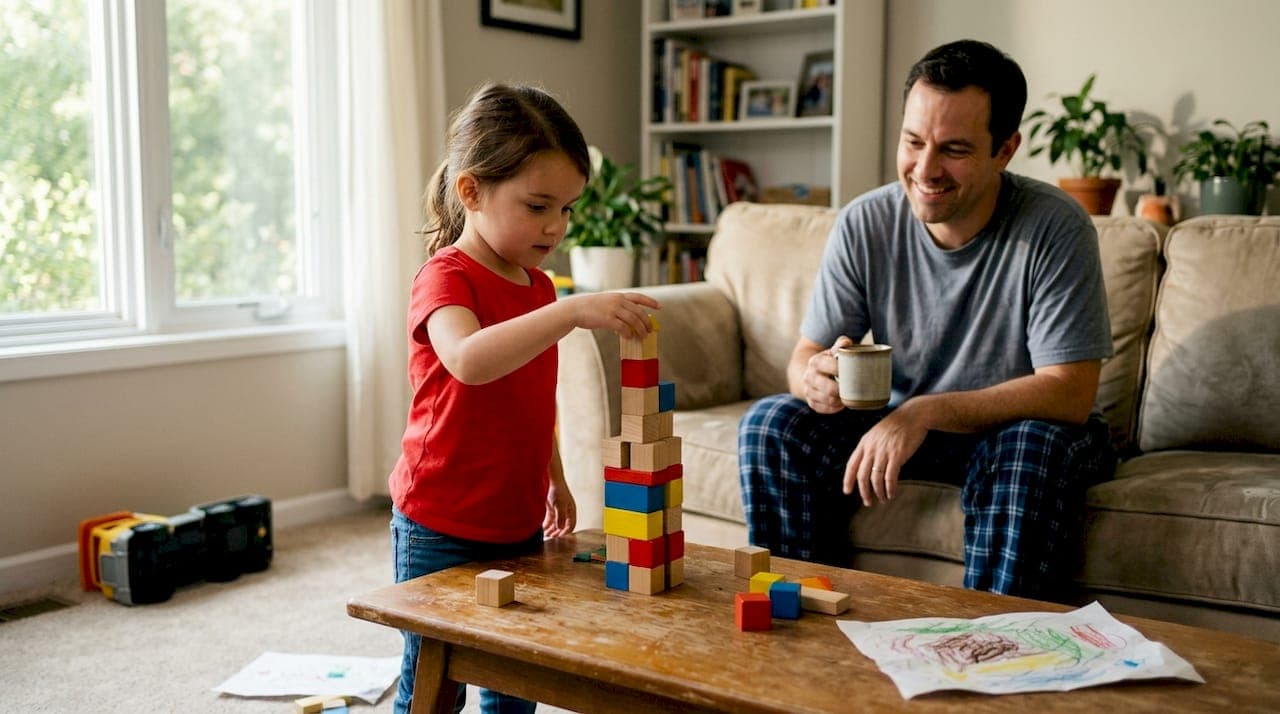
If you've ever watched your preschooler struggle with something a friend's child does easily, that quiet worry is completely normal. Many parents wonder whether their child is developing on track, and that uncertainty can feel isolating. Preschool milestones exist to give you a helpful map, not a report card. They describe the skills most children develop between ages three and five, and they provide a framework for understanding where your child is headed. This guide breaks down what milestones are, what to look for at each age, and how to use that knowledge to support your child's unique path toward kindergarten.
Table of Contents
- What are preschool milestones?
- Key milestones from ages 3 to 5
- How to use milestones: Guidance, not deadlines
- Preschool milestones and school readiness
- A fresh perspective: Seeing milestones as opportunities, not pressure
- Support your child's milestones with the right preschool program
- Frequently asked questions
Key Takeaways
| Point | Details |
|---|---|
| Milestones defined | Preschool milestones show typical skills most children reach by ages three to five. |
| Domains of development | Milestones span social, emotional, language, cognitive, and physical abilities. |
| Variation is normal | Children develop at their own pace, so milestones are guides, not deadlines. |
| Early action matters | Discuss concerns with your child's doctor and act early if you notice delays or loss of skills. |
| Readiness for school | Milestones help shape the skills children need for a successful start in kindergarten. |
What are preschool milestones?
Preschool milestones are specific skills and behaviors that mark a child's growth during the ages of three to five. Think of them as signposts along a trail. They tell you where most travelers are at a given point, but not every traveler walks the same pace or takes the exact same route.
Preschool milestones are tracked by the CDC in four domains and represent skills 75% or more of children achieve by each age. That number is important. It means that roughly one in four children may reach a milestone later than the listed age and still be developing typically. These are guidelines built from research across large groups of children, not absolutes.
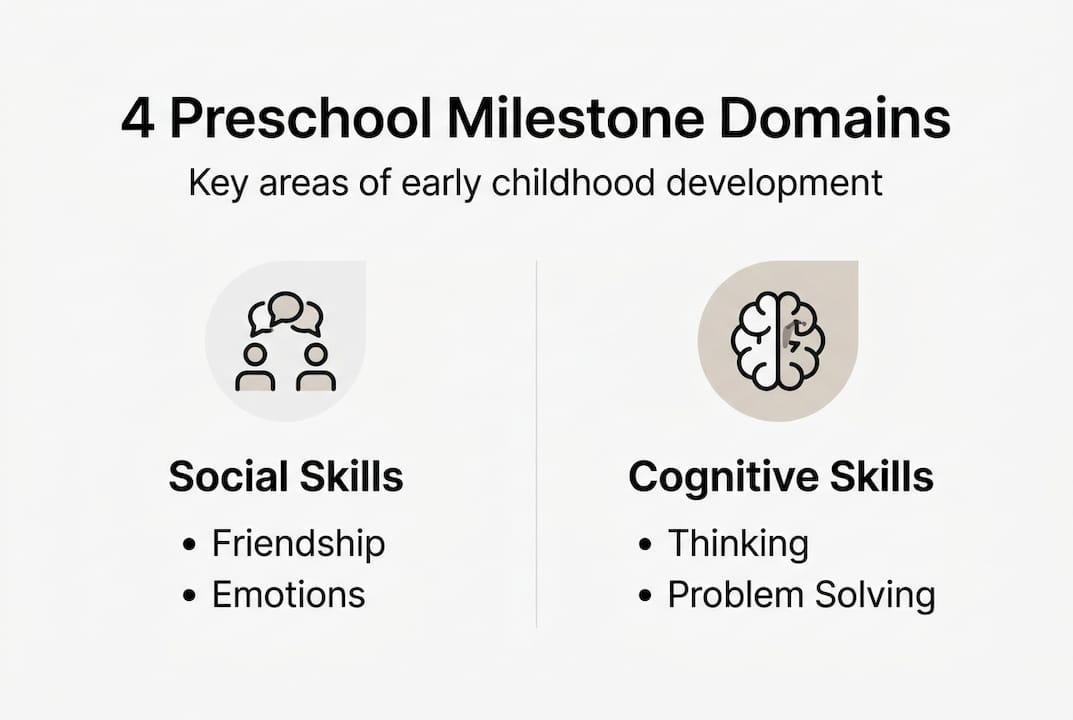
The four developmental domains cover different but connected areas of growth:
| Domain | What It Covers |
|---|---|
| Social and emotional | Making friends, managing emotions, cooperating with others |
| Language and communication | Talking, listening, understanding, early reading skills |
| Cognitive | Thinking, problem solving, memory, attention |
| Movement and physical | Gross motor skills like running, fine motor skills like drawing |
No domain works in isolation. A child who feels emotionally safe is more likely to try new things, which supports cognitive growth. A child who can hold a crayon with control is building the fine motor foundation for writing. The domains grow together, which is why building social and emotional skills matters just as much as early academics during these years.
Milestones matter because they help parents and caregivers spot patterns over time. If a child consistently seems to be skipping skills in one domain, that is useful information for a doctor or specialist. But seeing a milestone list and immediately worrying is not the goal. The goal is informed awareness, which is a very different thing.
"Milestones are meant to inform and empower families, not to rank children against each other. Early observation paired with early support, when needed, makes a real difference."
When you understand what the typical range of development looks like, you can celebrate your child's growth with real perspective and ask better questions when something does not feel right.
Key milestones from ages 3 to 5
With a solid understanding of what milestones are, let's break down exactly what to expect at each age from three to five.
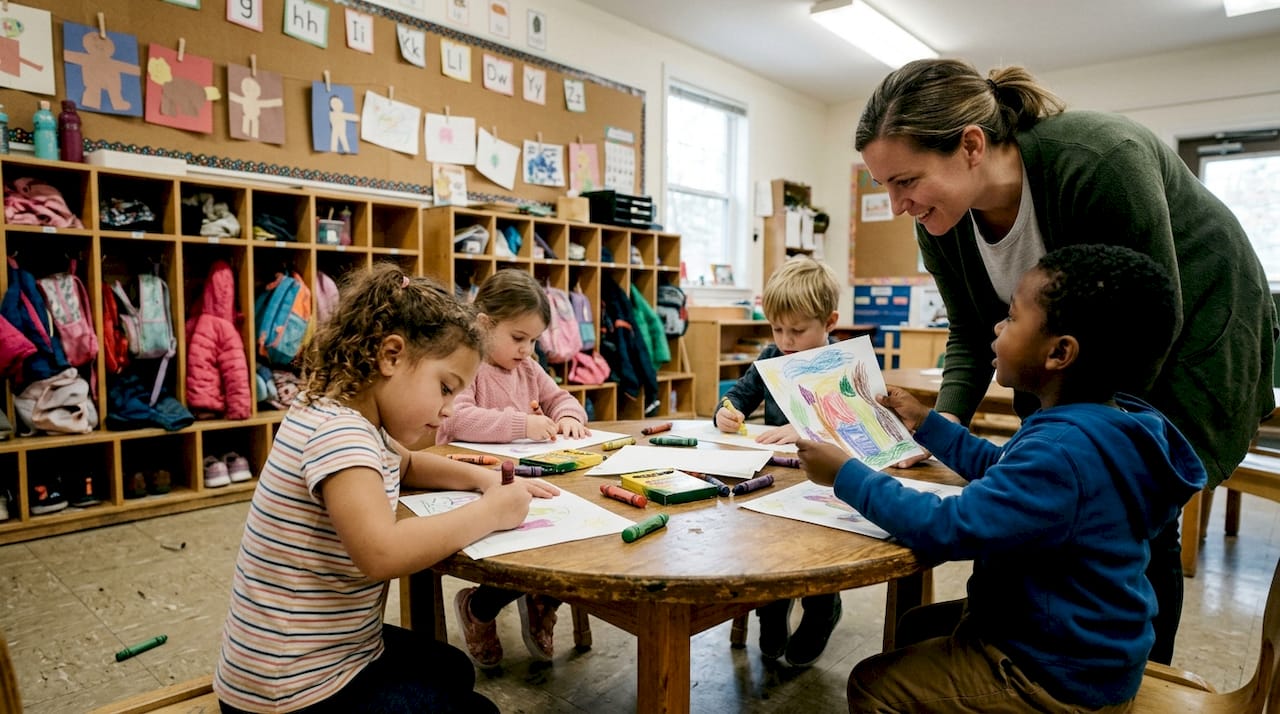
The changes between ages three and five are remarkable. Children move from parallel play (playing beside others) to true cooperative play. They go from speaking in short phrases to telling full stories. Here is a snapshot of what research shows most children achieve:
Age 3 highlights
- Social: Calms down within 10 minutes after a caregiver leaves, copies adults and older children
- Language: Says first name, age, and name of a sibling or friend
- Cognitive: Draws a circle when shown how
- Movement: Climbs, pedals and steers a tricycle
Age 4 highlights
- Social: Does new things confidently when encouraged, plays with other children in a group
- Language: Tells stories with at least two events
- Cognitive: Pays attention for five to ten minutes during engaging activities
- Movement: Hops on one foot, stands on one foot for about two seconds
According to CDC milestone checklists, these skills reflect what most children can do by each respective age across all four domains. By age 5, children are expected to follow multi-step rules in games, write some letters, count to ten, and manage short separations without distress. These are the building blocks for preparing for kindergarten success.
| Milestone Area | Age 3 | Age 4 |
|---|---|---|
| Social | Calms within 10 minutes | Joins group play confidently |
| Language | Says full name and age | Tells simple stories |
| Cognitive | Draws a circle | Focuses for 5-10 minutes |
| Movement | Pedals a tricycle | Hops on one foot |
A few things to keep in mind as you review these lists:
- Children often make rapid gains in one domain while slowing in another
- Stress, transitions, and illness can temporarily affect milestone progress
- The 75% benchmark means late achievement is still within the range of typical development
- Skills you practice together at home reinforce what children experience in a learning environment
The age-by-age view helps you notice patterns, but a single missed skill at one age rarely tells the whole story on its own.
How to use milestones: Guidance, not deadlines
Understanding what milestones to look for raises another question: how should parents interpret these lists, and what should they do if their child seems behind?
The short answer is: stay curious, not panicked. Individual variation is normal, but acting early when you have a genuine concern is always a smart move. The CDC's updated milestones use a 75% threshold precisely to make room for that natural variation while still giving families useful information.
Here is a practical approach if you notice a milestone hasn't appeared yet:
- Observe for a few weeks. Note specific behaviors, situations, and frequency. Context matters.
- Document what you see. Write down examples so you can share clear information with your child's doctor.
- Bring it up at the next checkup. Your pediatrician tracks development over time and will have the full picture.
- Ask about a referral if needed. Early intervention services can be incredibly effective when concerns are identified early.
- Keep the home environment warm and playful. Routine and structure in preschool settings and at home give children a safe base to practice emerging skills.
The CDC Milestone Tracker app is a genuinely useful tool. It walks you through age-by-age checklists, lets you log observations, and gives you a clear summary to share with your doctor. It removes a lot of the guesswork.
"Don't wait and see if you're concerned. Acting early gives children the best chance to get support when it matters most."
Pro Tip: Instead of checking off milestones like a to-do list, focus on celebrating your child's progress in context. Did they make eye contact during a story? Did they share a toy without being prompted? Those moments count.
Milestone lists can feel overwhelming when you read them all at once. Treat them like a reference guide you return to occasionally, not a weekly performance review.
Preschool milestones and school readiness
While milestones help parents observe important skills, how do they translate to preparing children for the next big step: kindergarten?
School readiness is not just about knowing the alphabet or counting to twenty. The AAP emphasizes readiness skills like focusing attention, impulse control, taking turns, early literacy and math, and emotional growth as core components of being ready for kindergarten. These are fundamentally milestone skills, developed across all four domains over the preschool years.
Here are the core readiness skills most kindergartens expect children to be developing:
- Attention and focus: Sitting and listening for short periods during group activities
- Impulse control: Waiting for a turn, raising a hand, pausing before acting
- Early literacy: Recognizing some letters, understanding that print carries meaning
- Emotional regulation: Naming feelings, using words instead of physical reactions
- Cooperation: Working alongside peers, following simple group rules
- Basic independence: Managing toileting, dressing, and lunch tasks with minimal support
These skills do not develop in isolation, and they do not develop on a rigid schedule. They grow through experience. A child who regularly plays in small groups, hears stories read aloud, and is encouraged to express their feelings in words is building all of these skills simultaneously.
High-quality preschool programs build readiness through daily routines, play-based learning, and intentional educator support. Choosing a nurturing preschool environment where your child feels safe to take risks and make mistakes is one of the most powerful things you can do to support readiness. According to the AAP's early childhood guidance, play-rich environments support the very skills kindergartens look for.
Pro Tip: Every child enters kindergarten with a different mix of strengths. Focus on growth, not gaps. A child who is emotionally regulated and loves books is already in a strong position, even if they can't yet write their full name.
A fresh perspective: Seeing milestones as opportunities, not pressure
After covering the major facts about preschool milestones and readiness, let's look at the common advice with a more realistic and reassuring point of view.
Here is something we have noticed after working with hundreds of young children: milestone anxiety often does more harm than good. When parents are hyper-focused on checklists, children pick up on that energy. They start to feel evaluated rather than supported, and play becomes a performance.
The truth is, most children develop in fits and starts. A child might surprise you with a leap forward in language one month, then seem to plateau in social skills for a bit. That is completely normal. What matters far more than hitting each milestone at the earliest possible moment is the quality of the environment surrounding the child.
Warm relationships, playful exploration, and play-based learning do more for development than any structured checklist program. We have seen children arrive at preschool hesitant to speak and leave kindergarten ready telling stories with confidence, not because anyone drilled them on milestones, but because they felt safe enough to grow.
Celebrate the small wins. Celebrate curiosity. That love of learning, built early, is worth more than any single skill checked off a list.
Support your child's milestones with the right preschool program
If you're ready to support your child's growth at every stage, choosing the right program can make all the difference.
At Martlet Academy, we design every part of the day around supporting each child's developmental journey. Whether your child is working on early social skills, building language, or getting ready for the transition to school, our team creates the kind of warm, structured environment where real growth happens naturally.
Our preschool program is built around play-based learning and intentional development across all four milestone domains. When the time comes, our kinder prep program bridges the gap between preschool and kindergarten with confidence-building experiences. Reach out today to learn how we can partner with your family.
Frequently asked questions
What are the four main domains of preschool milestones?
Preschool milestones are grouped into social/emotional, language/communication, cognitive, and movement/physical skills. The CDC tracks milestones across all four domains to give families a well-rounded picture of development.
What should I do if my preschooler misses a milestone?
Document your observations, bring them up with your child's doctor, and act early if concerned about missed milestones or any loss of skills your child previously had.
Is it normal for children to develop at different rates?
Yes, individual variation is expected. The CDC's 2022 milestone update shifted to a 75% threshold specifically to reflect that range of typical development.
How do milestones connect to kindergarten readiness?
Milestones track the development of attention, emotional regulation, early literacy, and social skills, all of which are central to school readiness. The AAP stresses milestone tracking as part of holistic preparation for kindergarten.
Recommended
- How Preschool Prepares Children for Kindergarten Success — Martlet Academy
- What to Look for in a Quality Preschool Program — Martlet Academy
- Preschool vs Daycare: What’s the Difference? — Martlet Academy
- The Role of Teachers in Early Childhood Development — Martlet Academy
- Pre-schooler parenting tips: practical advice for Ilford families