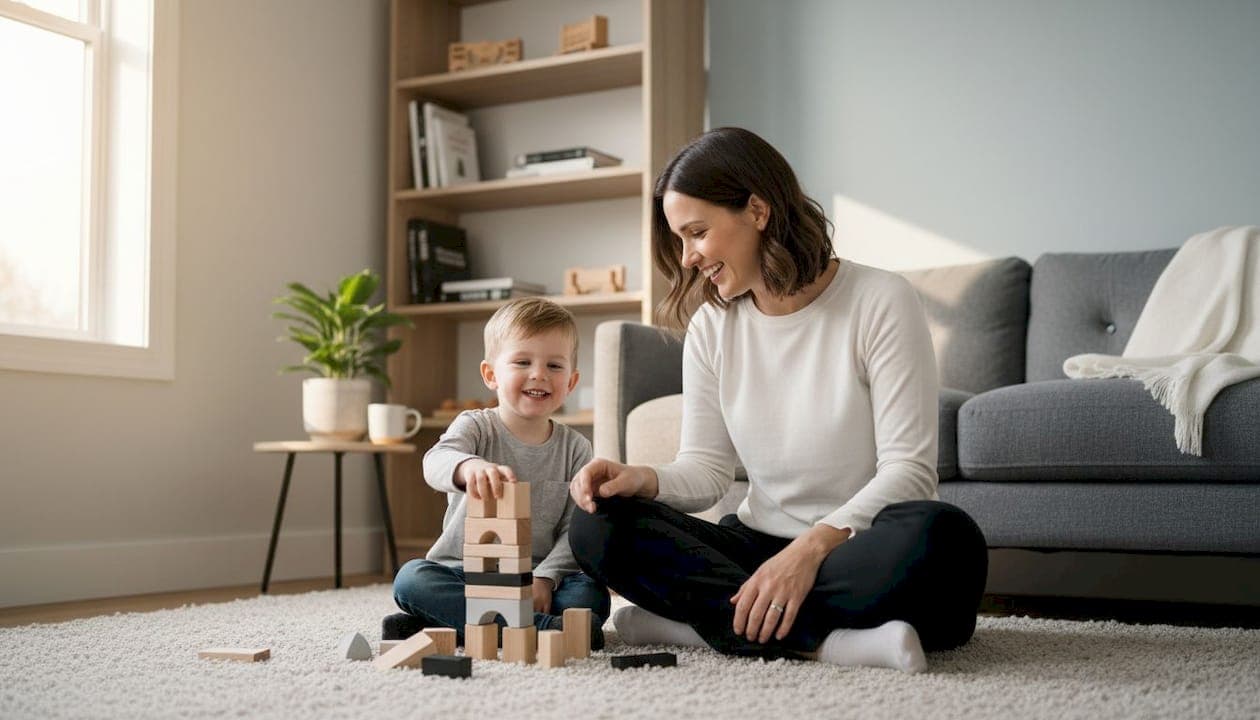
Play looks simple from the outside. A toddler stacking blocks, two preschoolers acting out a grocery store, a baby banging a spoon on a bowl. What most parents don't realize is that these moments are some of the most neurologically demanding activities a young child's brain will ever perform. Play interventions improve executive function, particularly skills like inhibitory control and cognitive flexibility, making playful experiences far more than entertainment. This article breaks down the science, clears up common misconceptions, and gives you concrete ways to use play intentionally every single day.
Table of Contents
- What cognitive skills does play build?
- How does movement and motor play affect cognition?
- Pretend play, self-regulation, and mental health: what's the link?
- The practical role of play in everyday parenting
- What most articles miss: nuance and real-world translation
- Find evidence-based play programs for your child
- Frequently asked questions
Key Takeaways
| Point | Details |
|---|---|
| Play boosts brain power | Research consistently links play to improved executive functions and cognitive growth in young children. |
| Movement matters | Motor skill-based play is especially effective for executive function and emotional development. |
| Pretend play supports mental health | Strong pretend play ability is associated with fewer behavioral challenges later on. |
| Quality over quantity | The type, context, and parent involvement in play matter more than simply increasing play time. |
| Expert guidance is key | American Academy of Pediatrics recommends varied, daily play to support cognitive and emotional well-being. |
What cognitive skills does play build?
Play shapes the brain in specific, measurable ways. Understanding which skills are affected helps you see why a child racing toy cars across the floor isn't wasting time. They're building the mental architecture needed for reading, math, relationships, and lifelong learning.
The area where research has the most to say is executive function. This umbrella term covers three foundational mental skills:
- Working memory: Holding information in mind while using it. Example: remembering the rules of a game while taking your turn.
- Inhibitory control: Resisting impulses and staying on task. Example: waiting before eating a snack during a pretend "restaurant" game.
- Cognitive flexibility: Shifting thinking when the situation changes. Example: adapting when a playmate changes the rules of a made-up story.
These skills predict academic success better than early IQ scores in many studies. That's not a small claim. It means investing in play early pays dividends for years.
Types of play and what they target
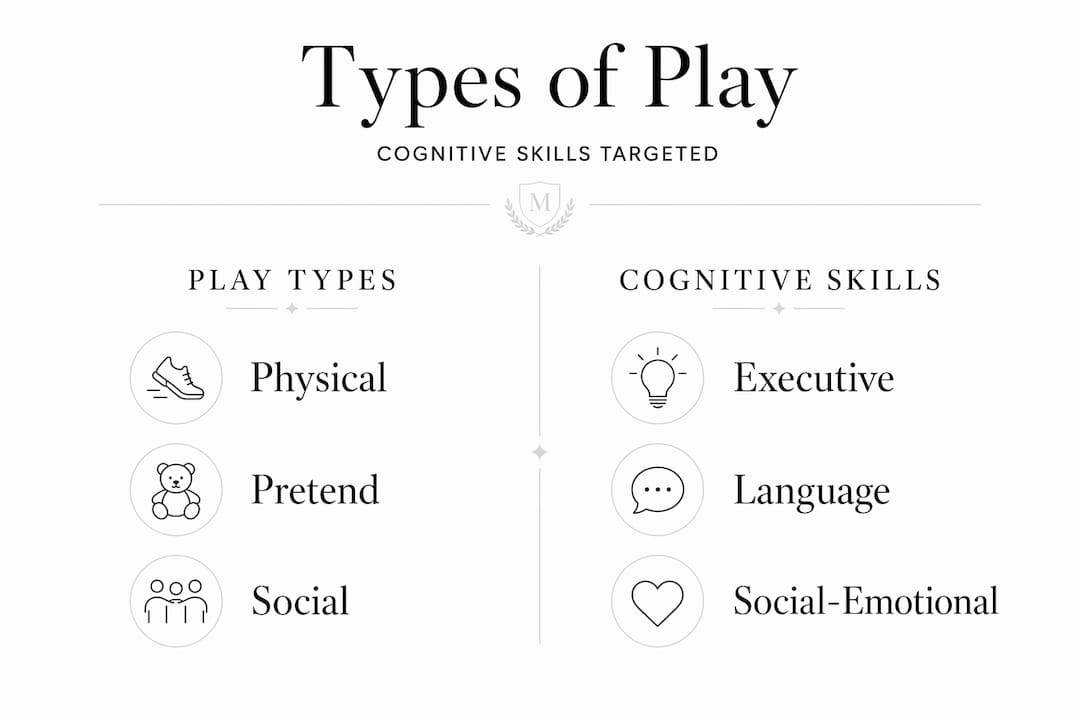
Not all play is created equal, but almost all play contributes something valuable. Here's how different types map to specific cognitive gains:
| Play type | Cognitive skills targeted | Example activities |
|---|---|---|
| Pretend/dramatic play | Working memory, inhibitory control | Playing house, acting out stories |
| Language-based play | Verbal reasoning, vocabulary | Rhyme games, storytelling, word play |
| Constructive play | Spatial reasoning, planning | Building with blocks, puzzles, drawing |
| Physical/movement play | Cognitive flexibility, attention | Obstacle courses, dancing, tag |
| Social play | Perspective-taking, self-regulation | Group games, cooperative building |
Research confirms that pretend play and executive function are meaningfully linked, with a small but statistically significant positive association found across multiple studies. Importantly, this 2026 meta-analysis notes that results are largely correlational and show variability across populations. That nuance matters. It means we shouldn't claim play causes genius-level thinking. But it strongly suggests that rich play experiences provide fertile ground for these skills to grow.
"Play-based learning environments offer children repeated opportunities to practice self-regulation, flexible thinking, and working memory in contexts that feel safe and intrinsically motivating." — Developmental research community consensus
Understanding play-based learning means recognizing that children don't just absorb facts through play. They practice mental processes, and that practice builds real cognitive capacity over time.
How does movement and motor play affect cognition?
While imaginative and language play matter, physical movement can supercharge cognitive growth. Here's how and why.
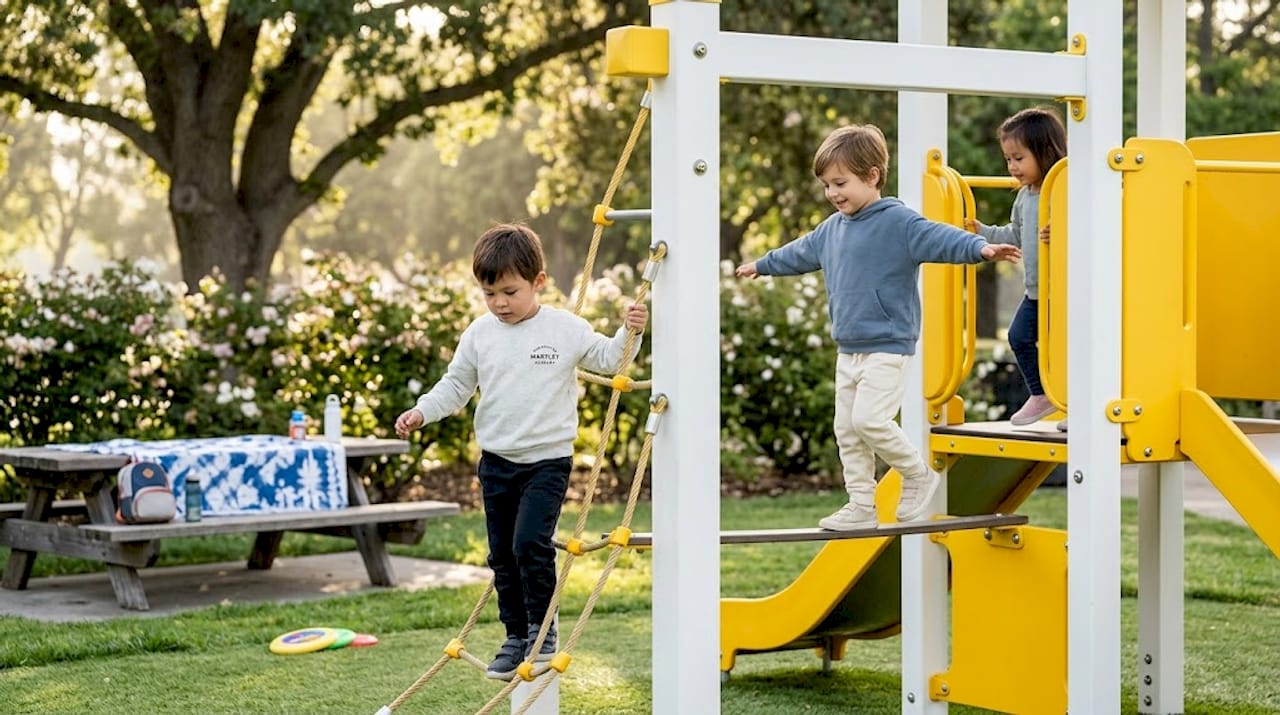
Most people think of movement play as good for the body. Running burns energy, climbing builds strength, jumping develops coordination. All of that is true. But there's a growing body of evidence showing that physical movement also builds the brain in ways that complement and sometimes exceed the effects of purely cognitive activities.
Motor activity and movement play are associated with significant executive function gains in young children, suggesting that the cognitive benefits of play may come from engaging multiple systems at once rather than from mental activity alone. When your child navigates an obstacle course, they're not just moving their body. They're planning, monitoring, adjusting, and problem-solving in real time. That's embodied learning, and it's powerful.
Why multi-system learning works
The brain doesn't process movement and thought in separate compartments. Physical activity increases blood flow and stimulates the release of brain-derived neurotrophic factor, a protein that supports the growth of new neural connections. In plain terms: movement feeds the brain.
For young children who are still developing their ability to sit still and focus, movement-based learning may be even more effective than desk-based instruction. Their bodies and brains are wired to learn together.
Comparing movement play formats
| Play format | Cognitive benefits | Best for ages |
|---|---|---|
| Unstructured outdoor play | Attention restoration, creativity | All ages |
| Structured movement games | Rule-following, self-regulation | 3 to 6 years |
| Dance and rhythm activities | Sequencing, working memory | 2 to 5 years |
| Balance and coordination tasks | Spatial awareness, focus | 18 months and up |
To maximize these benefits, here's how to integrate movement play daily:
- Start with morning movement. Even ten minutes of active play before learning activities improves attention and reduces fidgeting.
- Use movement to transition between activities. "Hop to the table" or "crawl to storytime" keeps energy moving productively.
- Make outdoor time non-negotiable. Even short outdoor sessions matter. Fresh air and varied terrain challenge the body and mind simultaneously.
- Build obstacle courses indoors. Pillows, chairs, and blankets create safe navigation challenges that demand planning and problem-solving.
- Follow your child's lead. When a child invents their own movement game, that self-direction builds executive function more deeply than following prescribed exercises.
Understanding motor skills in play reveals just how interconnected physical and cognitive development really are. The research on motor skills and development consistently shows that children who have rich movement experiences develop stronger attention, memory, and flexible thinking.
Pro Tip: You don't need a backyard or fancy equipment. Even a living room with cleared space and a few safe objects can become a rich movement environment. The key is frequency. Brief, daily movement sessions outperform occasional long ones.
For parents looking for encouraging motor skills through structured and unstructured play, the most important step is simply making physical activity a regular, joyful part of daily life rather than a scheduled obligation.
Pretend play, self-regulation, and mental health: what's the link?
With movement play's impact established, let's turn to pretend play and its surprising connection to mental health and self-regulation.
When your four-year-old insists on being "the teacher" and lines up stuffed animals as students, something remarkable is happening internally. They're managing roles, maintaining a narrative, regulating their emotional reactions to surprises in the story, and practicing being someone else entirely. This is cognitively and emotionally demanding work.
Early pretend play ability is associated with better mental health outcomes in later childhood, according to longitudinal research. Children who engaged in richer pretend play showed fewer emotional and behavioral difficulties down the road. This is not proof of causality. A child's natural temperament, home environment, and parental support all factor in. But the association is meaningful and worth taking seriously.
The likely mechanism is self-regulation practice. Pretend play supports executive functions because it requires children to adhere to the rules of a scenario and manage shifting roles. When playing pirates, you can't suddenly decide you're a spaceship. You hold the narrative together. That mental discipline directly parallels the self-regulation skills that protect children from anxiety, impulsivity, and behavioral difficulties later.
Here's what the evidence highlights about pretend play's role:
- Role-playing builds empathy. Acting as another person, even a fictional one, practices perspective-taking in real time.
- Narrative constraints train impulse control. Children regulate their own behavior to "stay in character," which mirrors real-life self-control.
- Emotional scenarios provide safe practice. Playing out conflict, fear, or loss in pretend contexts helps children develop coping language and strategies.
- Social pretend play adds complexity. Negotiating the storyline with a peer multiplies the cognitive and emotional demands, accelerating growth.
- Frequency and quality both matter. A child who spends five minutes in shallow pretend play gains less than one who sustains a rich, detailed scenario over thirty minutes.
Building social-emotional skills doesn't happen in isolation. It's woven into the fabric of imaginative play, which is one reason high-quality early childhood programs protect extended, uninterrupted play periods rather than fragmenting the day into short, task-based segments.
The practical role of play in everyday parenting
Now that the science is clear, here's how you can turn evidence into everyday action for your child.
Parents sometimes feel pressure to choose between structured learning activities and free play, as if they're competing priorities. They're not. The American Academy of Pediatrics emphasizes play as crucial for healthy development, explicitly including mental health and stress regulation pathways. Play is the vehicle, not the obstacle.
One of the most important things play does is reduce toxic stress. When young children face ongoing stressors like family tension, transitions, or uncertainty, unstructured play gives their nervous systems a chance to reset. It's not escapism. It's regulation.
Here's a practical daily framework:
- Protect morning free play. Before structured activities, let your child choose their own play for at least twenty minutes. This builds autonomy and self-direction.
- Schedule parent-child play daily. Even fifteen minutes of fully engaged, child-led play with a parent or caregiver produces measurable benefits for attachment and emotional regulation.
- Introduce guided play thoughtfully. Guided play, where an adult structures the environment but lets the child lead, bridges free play and intentional learning beautifully.
- Vary play environments. Indoors, outdoors, social, solo. Each setting builds different cognitive muscles.
- Limit screen time that displaces active play. The AAP's active play guidance is clear: physical, interactive play is non-negotiable for healthy development.
Stat to know: Children who receive at least one hour of daily active, engaged play show measurably better executive function development compared to children whose play time is regularly interrupted or replaced with passive activities.
The role of teachers in structuring quality play environments is just as important as what happens at home. When educators understand developmental science, they create classrooms that maximize the cognitive benefits of play without turning it into disguised busywork. Similarly, the connection between play and literacy is well-documented. Children who play with language through songs, rhymes, and storytelling arrive at reading with stronger phonological awareness and vocabulary.
Pro Tip: Resist the urge to always direct your child's play. Research consistently shows that child-led play produces stronger executive function outcomes than adult-directed play. Your job is to create the environment and step back, not to run the show.
What most articles miss: nuance and real-world translation
Here's where we want to be honest with you, because too much content about play and brain development oversimplifies the research in ways that don't actually help families.
The "play makes kids smarter" headline is technically supported by research. But it creates a misleading impression that any play, in any amount, automatically produces cognitive superstars. The reality is more nuanced and actually more encouraging.
Most of the research linking play to executive function and mental health outcomes is correlational. That means children who play more richly tend to show stronger cognitive outcomes. It does not mean play is a guaranteed intervention that produces specific results on a predictable timeline. Understanding play-based learning as a philosophy rather than a formula helps parents engage more authentically and less anxiously.
Quality matters more than quantity. A child who spends forty-five minutes in rich, imaginative, socially engaged play gains more than a child who spends three hours in low-level, repetitive activity. The texture of the play, including whether it involves narrative complexity, social negotiation, and problem-solving, shapes the outcomes more than the clock.
Parent involvement is a decisive factor. Children whose caregivers show genuine interest in their play, occasionally participate, ask open-ended questions, and provide emotionally safe environments for exploration develop faster across almost every measured domain. You don't need to turn play into a lesson. You just need to be present and engaged.
Finally, balance matters. The research doesn't support choosing one type of play over others. Free play, guided play, movement play, social play, and quiet solo play all contribute unique benefits. A child whose diet of play is varied and rich is far better served than one who gets large doses of a single type.
Find evidence-based play programs for your child
At Martlet Academy, we believe your child's best learning happens when play is purposeful, joyful, and supported by educators who understand the science.
Our programs are built around exactly the principles this article covers: a thoughtful blend of free and guided play, rich movement opportunities, imaginative learning, and strong family-educator partnerships. The infant program at Martlet Academy provides sensory-rich, relationship-first experiences designed for the youngest learners, while the toddler program expands into structured play experiences that build executive function, language, and motor skills. Every experience is grounded in developmental science and delivered with the warmth and consistency children need to thrive. Visit the Martlet Academy homepage to learn more about our approach, tour options, and enrollment.
Frequently asked questions
What types of play are best for cognitive development?
Movement, language, and pretend play each support executive functions and emotional health, but a varied mix ensures the broadest skill development across working memory, inhibitory control, and cognitive flexibility.
Does play help with emotional regulation and mental health?
Pretend play is associated with fewer emotional and behavioral difficulties in later childhood, though direct causality hasn't been proven and multiple factors influence outcomes.
How much movement-based play is recommended for cognitive gains?
Effective interventions in motor skill research typically include more than two sessions per week at around thirty minutes each, which produces the most meaningful executive function benefits.
What does "executive function" mean for my child?
Executive function covers flexible thinking, remembering and following multi-step instructions, and self-control. These skills shape learning and daily social behavior throughout childhood and beyond.
Do I need special toys or programs for effective play?
While curated early childhood programs provide structure and expertise, consistent daily parent-child play with ordinary household objects can be just as powerful for cognitive and emotional growth.