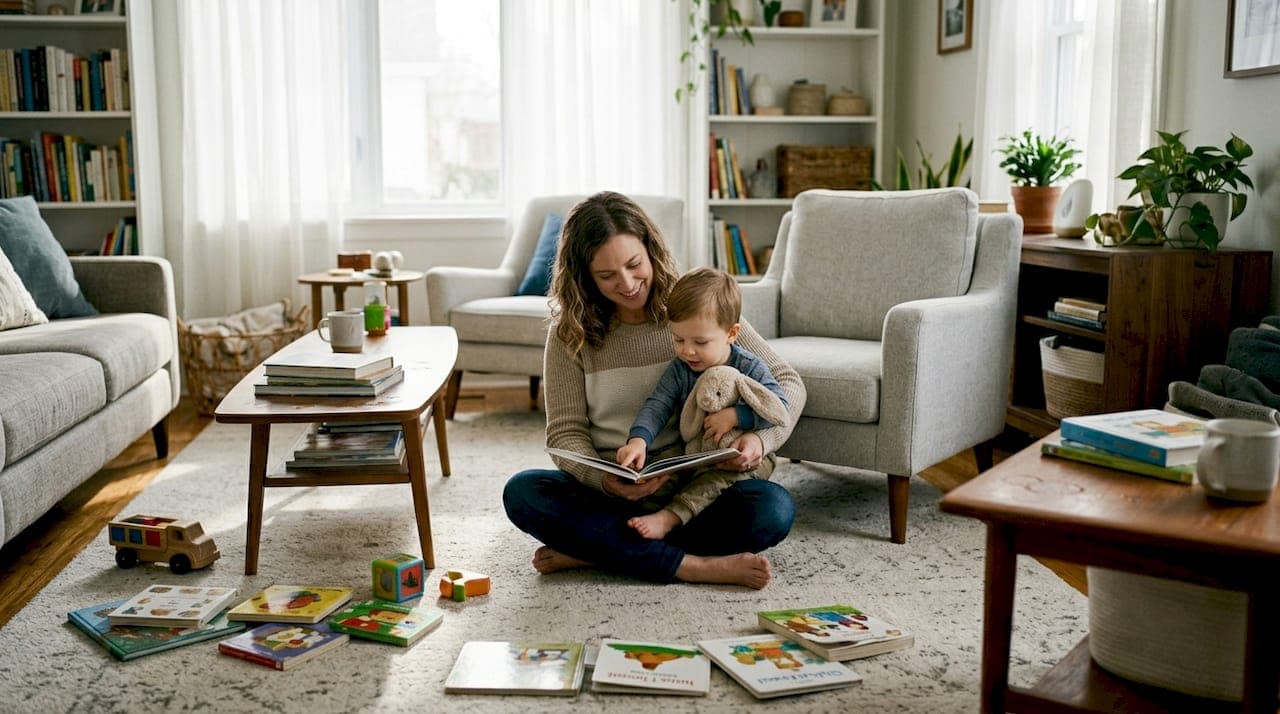
Early literacy isn't about flashcards, alphabet drills, or pushing your child to read before kindergarten. It begins the day your child is born, woven into every song you sing, every word you speak, and every board book you share at bedtime. Early literacy serves as the foundation for lifelong learning, reading proficiency, and cognitive development, emerging first through sensory exploration and simple play. This guide cuts through the confusion, explains what early literacy truly is, and gives you practical, research-backed strategies to support it naturally at home, starting right now.
Table of Contents
- What is early literacy? Foundations, skills, and myths
- Why early literacy matters: Cognitive, social, and lifelong impacts
- How early literacy develops: Play-based practices in daily life
- Balancing methods: Phonics, whole language, and what actually works
- Predictors of early literacy success: What parents can influence
- Our take: Why playful, responsive parenting outperforms early academics
- How Martlet Academy supports your child's literacy journey
- Frequently asked questions
Key Takeaways
| Point | Details |
|---|---|
| Early literacy starts at birth | Playful, everyday interactions lay crucial groundwork for reading and cognitive growth. |
| Play-based routines are best | Songs, stories, and conversation develop key skills better than early academics or screens. |
| Balanced approach beats extremes | Mix phonics and whole language for optimal results—avoid overemphasizing one method. |
| Home environment matters most | Rich communication and access to books at home greatly increase early literacy success. |
What is early literacy? Foundations, skills, and myths
Many parents picture early literacy as teaching the ABCs or sounding out words before preschool. In reality, it is a broad set of skills and experiences that prepare children to eventually read and write, skills that grow long before a child picks up a book independently. Early literacy encompasses skills like print awareness, phonological awareness, vocabulary, and alphabet knowledge, all of which build the lifelong learning foundations children need to thrive.
Here is a quick look at the core components and how they show up in early childhood:
| Skill | What it looks like in young children |
|---|---|
| Print awareness | Pointing to words on a page, holding a book right-side up |
| Phonological awareness | Clapping syllables, recognizing rhymes, playing with sounds |
| Vocabulary | Using and understanding an expanding bank of words |
| Alphabet knowledge | Recognizing letters, connecting names to shapes |
| Narrative skills | Retelling stories, describing events in sequence |
Some myths worth setting aside:
- Myth: Starting reading instruction earlier always produces stronger readers. Children develop at different paces, and pushing formal instruction too soon can backfire.
- Myth: Only school prepares children for literacy. Home conversations, songs, and stories are often the richest literacy experiences a child has.
- Myth: If a child isn't interested in books, there's a problem. Interest in stories and print builds gradually through exposure and play, not pressure.
"Preliterate experiences, from playing with sounds to exploring picture books, are not preliminary to real learning. They are the real learning." — Early childhood literacy researchers
Think of early literacy as soil preparation. You are not planting the tree yet. You are making sure the ground is rich, warm, and ready.
Why early literacy matters: Cognitive, social, and lifelong impacts
Early literacy experiences shape far more than future reading scores. They influence how children think, regulate their emotions, connect with others, and approach challenges for the rest of their lives. Research makes the stakes clear: developmental delays were highest in literacy-numeracy domains at 71.37%, with social-emotional delays following at 27.57%.
That 71% figure matters. It tells us that literacy-numeracy is one of the most vulnerable areas of early childhood development, and that the gap between children with rich early literacy environments and those without is significant.
Strong early literacy is connected to:
- Better cognitive flexibility and problem-solving
- Stronger social and emotional skills and self-regulation
- Greater confidence when starting school
- Improved communication across all settings
- Higher preschool and kindergarten readiness
Key predictors of strong literacy outcomes include access to books at home, parental education level, participation in early childhood education programs, and household economic resources. Many of these overlap. A family with more books tends to have more conversations about those books. A child in a quality preschool hears a richer vocabulary daily.
Pro Tip: You don't need a large book collection to make a difference. Your local library is a powerful, free resource. Choose five to eight books at a time, rotate them every two weeks, and make reading a predictable part of your daily rhythm, whether at breakfast, bath time, or before bed. Responsiveness matters more than volume. When you pause, point, and respond to your child's reactions during reading, you multiply the benefit dramatically. Resources like developing literacy skills in preschool reinforce that conversation around books counts as much as the reading itself.
How early literacy develops: Play-based practices in daily life
You don't need a curriculum binder or a designated "learning time" to build early literacy. The best literacy development happens inside ordinary moments. Here is how to fold it naturally into your day:
- Read aloud daily. Even ten minutes of shared reading builds print awareness, vocabulary, and a love of stories. Point to words as you read. Ask open questions like "What do you think happens next?"
- Sing songs and nursery rhymes. Rhyming and rhythm are powerful tools for play-based learning. They train children to hear the sounds that make up words, a core phonological skill.
- Label your world. Tape simple labels on household items. Point out signs during errands. Environmental print (stop signs, cereal boxes, store names) is a child's first real-world reading experience.
- Encourage pretend play. When children play restaurant, doctor, or store, they narrate, sequence events, and build vocabulary. All of this feeds literacy growth.
- Scribble and draw freely. Pre-writing marks, even chaotic ones, strengthen fine motor skills and signal that written language has meaning.
- Have real conversations. Ask your child about their day, their feelings, and their ideas. Early communication strategies confirm that back-and-forth dialogue builds language faster than one-sided instruction.
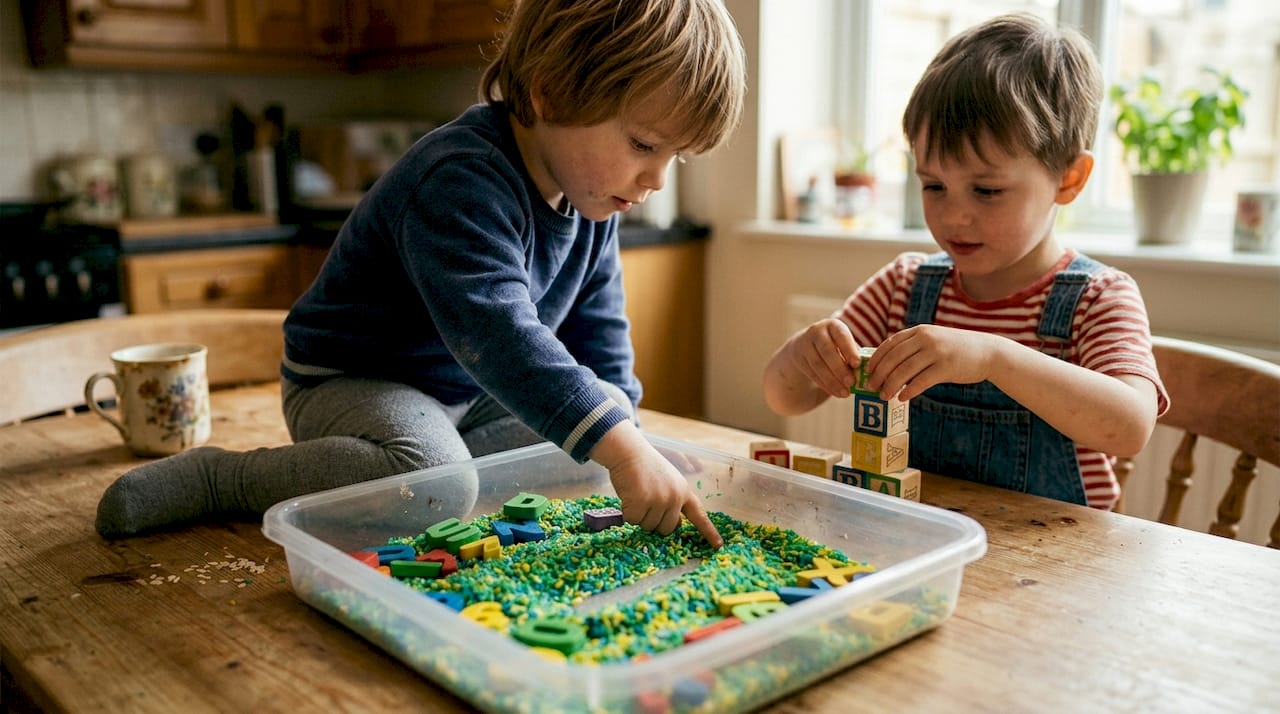
The research is clear: sensory trays, rhyming games, pretend play, and environmental print exploration are not just fun activities. They are the architecture of early literacy.
Pro Tip: If your family speaks a language other than English at home, keep using it. Literacy skills transfer across languages. A child who builds strong narrative skills in Spanish or Tagalog carries those skills into English learning too.
Signs of healthy literacy growth to watch for:
- Showing interest in books and pictures
- Recognizing their own name in print
- Playing with rhymes or making up silly words
- Retelling simple stories or events
- Pretending to write or read independently
Balancing methods: Phonics, whole language, and what actually works
You may have heard about the so-called "Reading Wars," the long-running debate between phonics instruction and whole language approaches. Here is what you actually need to know.
Phonics focuses on teaching children the links between letters and sounds so they can decode new words. Whole language prioritizes meaning, context, and a love of reading, trusting that children absorb patterns naturally through rich reading experiences. Both have genuine strengths.
| Approach | Strengths | Limitations |
|---|---|---|
| Phonics | Builds strong decoding and word recognition | Can feel mechanical without meaningful context |
| Whole language | Builds comprehension, engagement, and motivation | May leave gaps in decoding for some children |
| Balanced literacy | Integrates both; adapts to individual needs | Requires thoughtful, skilled implementation |
Most experts now support a balanced literacy perspectives approach, combining structured phonics with rich, engaging reading experiences. Phonics excels in decoding and word recognition supported by strong meta-analyses, while whole language adds comprehension and genuine love of reading through context.
"Drilling phonics without meaning is like teaching someone the rules of grammar without ever letting them hold a conversation. Both sides of the equation matter."
At home, the balance looks like this: play rhyming games and clap syllables (phonological awareness), while also reading stories your child genuinely loves (whole language engagement). You do not need to pick a side. The richest early literacy environments blend both naturally.
Predictors of early literacy success: What parents can influence
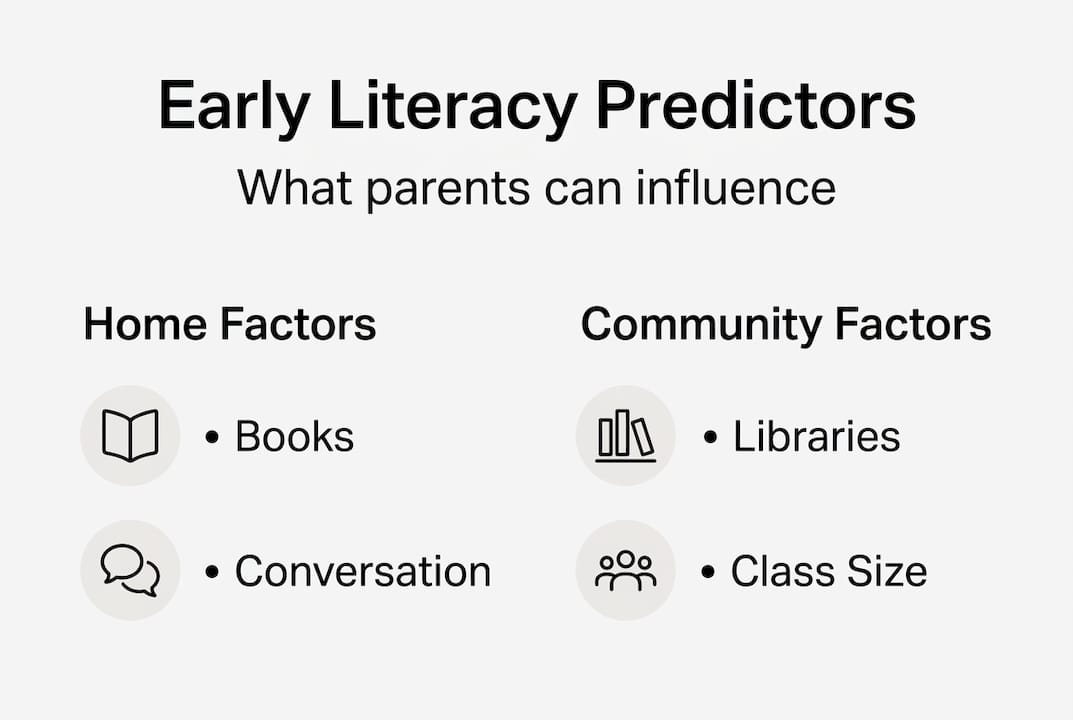
Some factors that shape early literacy are outside your control. Others are not. Knowing the difference helps you focus your energy where it counts.
| Predictor | Parental influence |
|---|---|
| Books at home | High: build a rotating library, use public libraries |
| Conversations and responsive talk | High: daily dialogue, open-ended questions |
| Early childhood education | Moderate: choosing quality programs matters |
| Maternal/parental education level | Low: not changeable, but its impact can be offset |
| Household wealth | Low: free community resources can bridge gaps |
Developmental delays in literacy-numeracy are predicted by access to books, parental education, the child's age, economic resources, and early education participation. But here is the important nuance: responsive parenting and intentional routines can close meaningful gaps even in lower-resource environments.
Steps you can take today:
- Build a reading routine of at least ten to fifteen minutes daily
- Ask your library about free early literacy programs
- Choose preschool programs that emphasize nurturing learning environments
- Look for quality preschool factors like low ratios and language-rich classrooms
- Prioritize real conversation over passive screen time
Small class sizes in early education settings also make a measurable difference because they allow educators to respond individually to each child's literacy cues and needs.
Our take: Why playful, responsive parenting outperforms early academics
Here is something that surprises many parents we talk with: pushing structured academic instruction before a child is developmentally ready often produces worse outcomes than a play-rich, responsive home environment. This is not a soft, feel-good opinion. It is what the evidence consistently shows.
Children learn language and literacy best when they feel emotionally safe, when adults follow their lead, and when learning feels like discovery rather than performance. The most powerful thing you can do is not drill letters. It is to have real conversations, respond to your child's curiosity, and make books a joyful part of your shared life.
We see this regularly in early childhood settings. Children who arrive with rich play and conversation backgrounds often outpace those who had formal instruction, because they come in confident, curious, and motivated. Why play-based matters comes down to this: play is how children process the world, and processing is how they learn.
Pro Tip: If you are worried your child seems "behind," start with more conversation before reaching for workbooks. Ask them questions, narrate your day together, and let them lead play. You will often see growth faster than you expect.
How Martlet Academy supports your child's literacy journey
Everything in this guide, from responsive conversation to play-based routines and balanced literacy methods, reflects the approach we bring to every classroom at Martlet Academy. We believe early literacy grows best in environments where children feel safe, seen, and genuinely engaged.
Our Infant Program, Toddler Program, and Preschool Program are each designed to meet children exactly where they are, building language, curiosity, and confidence through intentional, play-centered experiences. Families are partners in this process, not just observers. If you are ready to explore what a nurturing, literacy-rich early education looks like in practice, we would love to connect with you.
Frequently asked questions
When should we start building early literacy skills?
You can start the day your child is born. Early literacy begins at birth through sensory exploration and everyday interactions like talking, singing, and reading together.
Does reading to my baby really make a difference?
Absolutely. Daily shared reading builds vocabulary, print awareness, and academic readiness. Sharing books and conversations consistently improves literacy outcomes across all ages.
Do English language dialects or home languages hold my child back in literacy?
No. Culturally sustaining practices that preserve home languages and dialects actually support early literacy development while children simultaneously build English skills.
What if my child isn't interested in books yet?
Try songs, rhymes, and pretend play before pushing formal book time. Play-based activities like rhyming games and sensory play naturally build the same foundational skills.
Are screens effective for early literacy development?
Not as effective as real interaction. Play, not screens, drives lasting early literacy growth because it involves back-and-forth responsiveness that passive screen time cannot replicate.
Recommended
- Play-Based Learning: How Children Learn Best in Preschool — Martlet Academy
- Why Early Childhood Education Shapes Lifelong Learning — Martlet Academy
- The Role of Teachers in Early Childhood Development — Martlet Academy
- Creating a Safe and Nurturing Preschool Learning Environment — Martlet Academy
- Pre-schooler parenting tips: practical advice for Ilford families