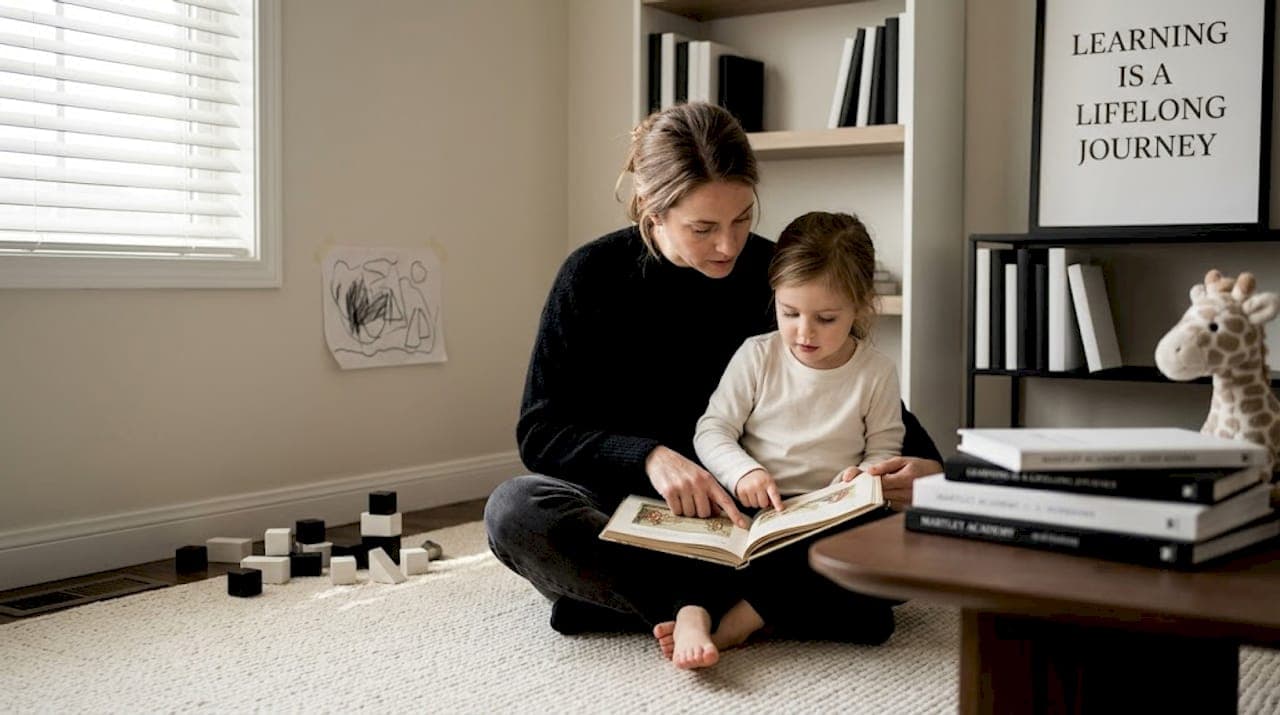
Most parents assume that learning to read begins on the first day of kindergarten, when a teacher holds up a flashcard and the real work starts. That assumption, while understandable, leaves years of critical development on the table. Early literacy education actually begins at birth, woven into every lullaby, every bedtime story, and every simple conversation you have with your child. Understanding what early literacy really means gives you the power to nurture your child's foundation long before school ever begins, and the research makes it clear that those early years matter enormously.
Table of Contents
- Defining early literacy education
- Core components: what skills make up early literacy?
- How do children develop early literacy skills?
- Supporting early literacy at home: what really works?
- Finding balance: avoiding pitfalls with early literacy instruction
- A fresh perspective: the heart of early literacy isn't flashcards or pressure
- Explore supportive early learning programs
- Frequently asked questions
Key Takeaways
| Point | Details |
|---|---|
| Early start matters | Early literacy development begins from birth and sets the foundation for lifelong learning. |
| Focus on core skills | Oral language, sound awareness, and print exposure build readiness for reading. |
| Parent involvement counts | Regular conversations, reading together, and playful word games make the biggest difference at home. |
| Balance is key | Avoid over-focusing on drills and phonics—nurture comprehension, confidence, and a love for stories instead. |
| Programs help families | Partnering with supportive early learning programs can extend and reinforce your child's literacy development. |
Defining early literacy education
Early literacy is not the same thing as teaching a child to read. That distinction matters more than most parents realize. Formal reading instruction follows a set sequence of phonics rules and decoding strategies, typically introduced in kindergarten or first grade. Early literacy, by contrast, is everything that happens before that moment.
As defined by literacy researchers, "early literacy education refers to the foundational knowledge, skills, and attitudes children develop from birth before conventional reading and writing, including oral language, phonological awareness, print awareness, letter knowledge, vocabulary, and emergent writing." That definition is worth sitting with for a moment because it is remarkably broad.
Early literacy covers six major domains:
- Oral language: The ability to understand and produce spoken words
- Phonological awareness: Recognizing and playing with the sounds that make up words
- Print awareness: Understanding that marks on a page carry meaning
- Letter knowledge: Learning the shapes, names, and sounds of letters
- Vocabulary: Building a growing bank of word meanings
- Emergent writing: Experimenting with marks, symbols, and eventually letters
The good news is that none of these skills require worksheets or drills. They develop naturally through conversation, pretend play, singing, and shared reading. Supporting lifelong learning benefits through these everyday moments is not a parenting hack; it is simply how children are wired to learn.
"Children do not need to be formally taught to love language. They need to be surrounded by it." This principle guides every effective early literacy approach: exposure first, instruction later.
Pro Tip: Think of early literacy as building a house. The foundation is laid in the first five years. You would not skip the foundation and go straight to the roof. Laying it well through talk, play, and stories makes everything else structurally sound.
What you are really doing during those first years is creating readiness, not rushing formal instruction. Play-based learning is one of the most powerful vehicles for this readiness, because children practice language, narrative, and symbol understanding every time they play.
Core components: what skills make up early literacy?
With an understanding of what early literacy is, let's break down the specific skills that matter most in the early years. Each component plays a distinct role, and they all work together rather than in isolation.
Research on reading readiness confirms that key mechanics include phonological awareness (rhyme, syllables, phonemes), print awareness (text direction, word boundaries), alphabetic principle (letter-sound links), vocabulary building, and comprehension precursors. Here is what each one looks like in practice:
- Phonological awareness starts with noticing that "cat" rhymes with "hat," then builds toward identifying individual sounds inside words. Clapping syllables in names like "A-lex-an-der" is a perfect kitchen-table activity.
- Print awareness develops when a toddler watches you follow words across a page with your finger or points at a stop sign and asks what it says. It is the understanding that text has direction, spaces, and purpose.
- Alphabet knowledge grows through song, play, and exposure rather than rote memorization. Recognizing the first letter of their own name is usually a child's first meaningful alphabet connection.
- Vocabulary development is perhaps the most influenced by the adult environment. Every time you name something, describe a feeling, or explain why something works, you are adding to your child's word bank.
- Comprehension precursors are skills like recalling what happened in a story, predicting what comes next, and making connections between a book and real life. These are the seeds of reading comprehension.
| Skill | What it looks like at age 3 | What it looks like at age 5 |
|---|---|---|
| Phonological awareness | Enjoys nursery rhymes | Can identify the first sound in a word |
| Print awareness | Knows books are read front to back | Understands words have spaces between them |
| Alphabet knowledge | Recognizes a few letters | Knows most letter names and some sounds |
| Vocabulary | Uses 900 to 1,000 words | Uses 2,000+ words with more nuance |
| Comprehension | Recalls one or two story events | Retells a story in sequence |
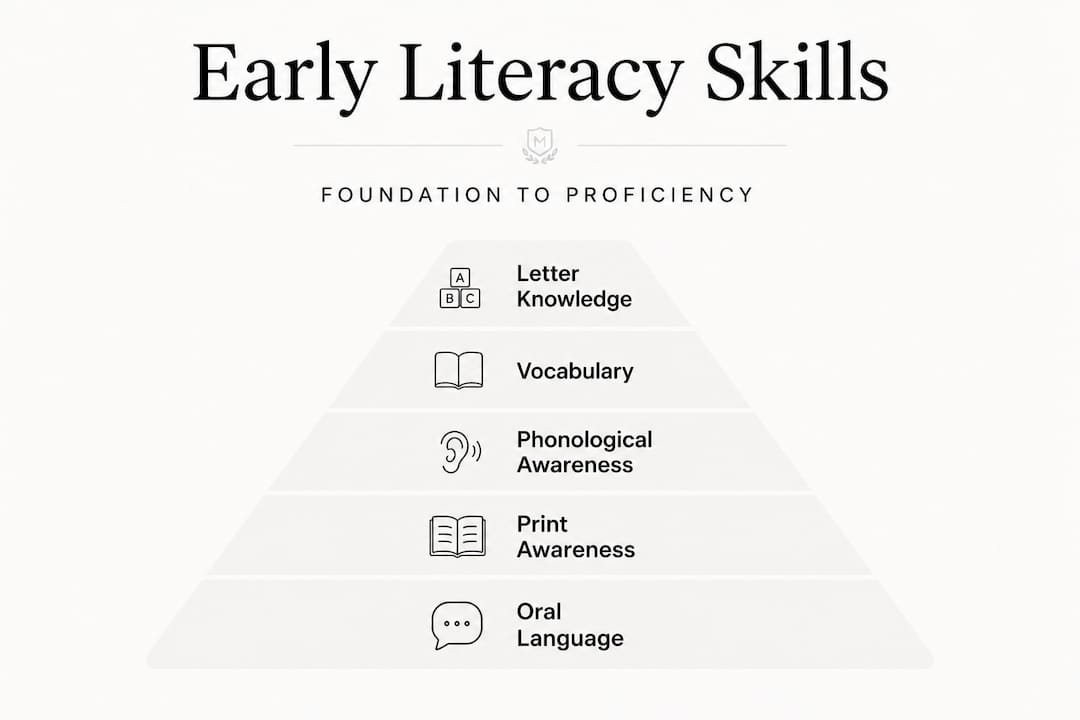
Creating a nurturing preschool environment where these skills are practiced playfully, rather than pressured, makes a significant difference in how children feel about reading long term. Communication strategies between educators and families also reinforce these skills across both settings, creating a consistent literacy-rich world for the child.
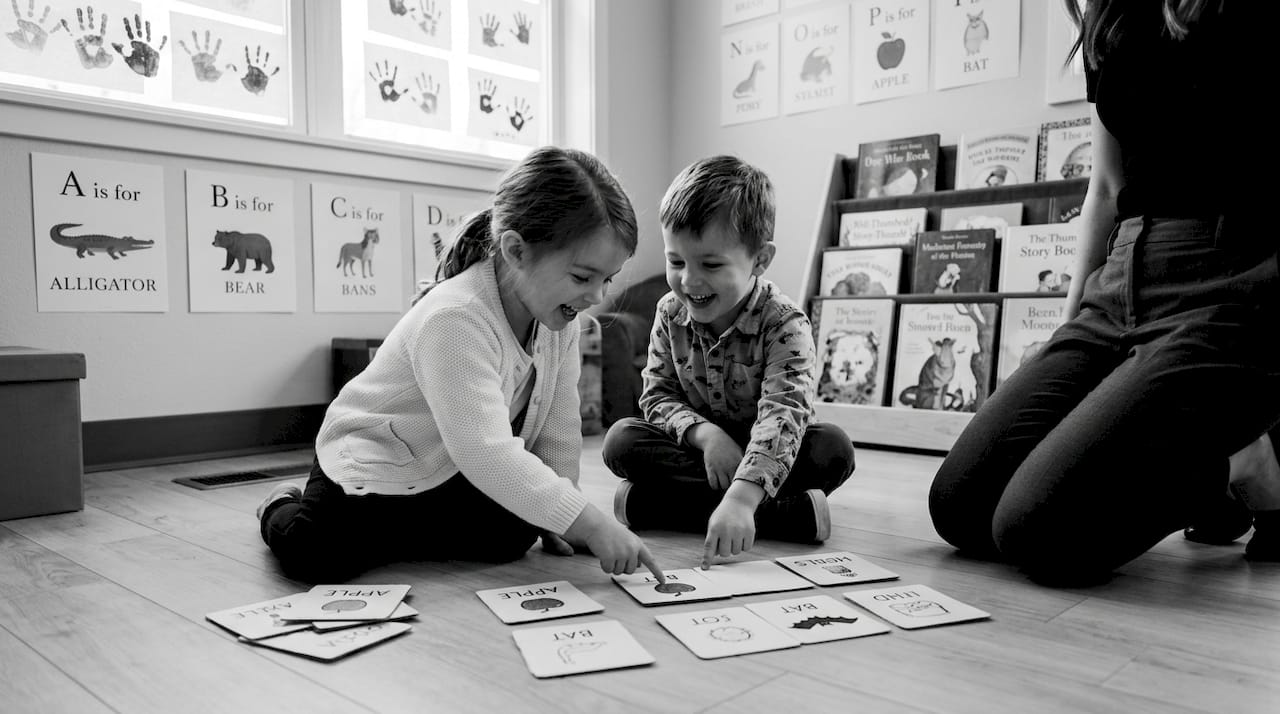
Pro Tip: You do not need special materials. Label items around your home with sticky notes, play "I spy something that starts with the 'mmm' sound," and let your child scribble freely. These casual moments build all five skill areas simultaneously.
How do children develop early literacy skills?
Having covered the core skills, it is helpful to see how children typically acquire them and what reliable milestones look like. Development is sequential but not rigid. Each child follows a general path, though the timeline can vary considerably.
In the first year, babies respond to the rhythm and tone of speech before they understand words. They babble, imitate sounds, and begin to recognize familiar voices. By 18 months, most toddlers are connecting words to objects and enjoying simple board books. By age three, children typically engage in pretend play with narrative structure, enjoy being read to, and begin noticing environmental print like fast-food signs or cereal boxes.
Empirical benchmarks suggest that by the end of pre-K, children should demonstrate measurable skills in print and letter knowledge assessments, and phonemic awareness is consistently identified by the National Reading Panel as the strongest predictor of later reading success. This is worth knowing because it tells you where to put your energy.
What shapes these milestones most powerfully? Adult interaction. Research from the IES evaluation of Early Reading First programs found that the quantity and quality of adult talk directly predict a child's speech production and vocabulary growth. Structured programs improved print and letter knowledge significantly, but the most durable gains came from rich, conversational environments.
Key developmental markers to look for:
- Birth to 12 months: Responds to sounds and voices, babbles back and forth with caregivers
- 12 to 24 months: Says first words, points at pictures in books, follows simple two-step directions
- 2 to 3 years: Listens to short stories, names familiar objects, begins pretend reading
- 3 to 4 years: Recognizes some letters, especially in their own name, enjoys rhymes and songs
- 4 to 5 years: Identifies beginning sounds in words, holds a book correctly, attempts to write letters
Supporting your child toward kindergarten readiness is not about drilling these milestones. It is about creating the rich daily interactions that allow milestones to emerge naturally. The role teachers play in this process is significant, particularly for children who need more support, but home remains the most powerful literacy environment of all.
Supporting early literacy at home: what really works?
Understanding milestones means parents can now take concrete steps to give their children the best foundation through simple, everyday actions. The research here is both encouraging and practical.
Guidance from the IES on supporting emergent literacy at home highlights these evidence-backed strategies: daily shared reading where you point to words and discuss stories, phonological games using rhymes and sound play, print exposure through labels and signs in the environment, and rich conversations that actively build vocabulary. Critically, the guidance cautions against rushing formal reading instruction before children are developmentally ready.
Here are six practical ways to build early literacy every day:
- Read together daily. Even ten minutes of shared reading builds vocabulary, comprehension, and book familiarity. Let your child choose the book. Repeated readings of favorites are perfectly fine and actually deepen learning.
- Talk through everything. Narrate your day. "We're putting the red apples in the cart." Simple narration introduces vocabulary, sentence structure, and descriptive language without any effort.
- Play with sounds. Make up silly rhymes, clap syllables in names, or play "first sound" games during car rides. These activities build phonological awareness in a genuinely fun way.
- Make print part of life. Point out words on cereal boxes, street signs, menus, and grocery lists. When children see that print is everywhere and meaningful, they become motivated to decode it.
- Ask open-ended questions. After reading, ask "What do you think will happen next?" or "Why do you think she felt sad?" These questions build comprehension thinking, not just memory.
- Let them write freely. Give children crayons and paper with no agenda. Scribbles become shapes. Shapes become letters. The process matters more than the product.
One finding that surprises many parents is that home language-rich environments from birth are more critical than socioeconomic factors when it comes to early literacy outcomes. Adult input quality matters more than income level. That is genuinely empowering. It means that what you do and say at home has tremendous influence, regardless of your resources.
Building routine and structure around these activities also helps. A consistent bedtime story ritual, a song during diaper changes, a word game during dinner all create predictable, comforting literacy experiences that children look forward to and thrive within.
Pro Tip: Start a "word of the week" tradition. Pick an interesting word like "enormous" or "glimmer" and use it throughout the week in different contexts. Children love showing off new words, and rich vocabulary is one of the strongest predictors of reading comprehension later on.
Finding balance: avoiding pitfalls with early literacy instruction
While supporting literacy at home, it is just as important to understand what not to overdo, especially as your child approaches school age. Good intentions can sometimes lead to approaches that backfire.
Phonics instruction is genuinely valuable. It gives children a reliable system for decoding unfamiliar words. But over-teaching phonics carries real risks: it can crowd out the reading-for-pleasure experiences that build fluency and comprehension, and it may actually dampen a child's motivation to read if the process feels like drills rather than discovery.
A balanced approach looks like this:
- Weave phonics awareness into games rather than workbooks
- Prioritize reading aloud for comprehension and enjoyment alongside any sound work
- Build background knowledge through conversations, outings, and varied books
- Watch for signs of anxiety or resistance and ease off structured activities when they appear
- Remember that oral language and real-world knowledge support comprehension just as much as decoding skills
"A child who loves books but cannot yet decode every word is on a far better trajectory than one who can phonetically sound out syllables but finds reading joyless."
Supporting social and emotional skills alongside literacy is not a distraction from reading development. It is central to it. Children who feel confident and emotionally secure engage more readily with new learning, including the sometimes-frustrating process of learning to read.
A fresh perspective: the heart of early literacy isn't flashcards or pressure
After digesting both the dos and the don'ts, there is something most families really need to hear that conventional advice often overlooks. We see it constantly in early childhood education: parents arrive carrying the weight of comparison and timeline anxiety, worrying that their neighbor's child already knows the alphabet at two and wondering if they are falling behind.
Here is the truth. The families who produce the most confident, enthusiastic early readers are not the ones who started flashcards earliest. They are the ones who talked the most, read the most, played the most, and made language feel like home. The lifelong impact of early education is built on relationships, not on drills.
When a grandparent reads the same picture book fourteen times in a row because a toddler demands it, something profound is happening. The child is not just memorizing the story. They are internalizing narrative structure, vocabulary, print concepts, and the deeply comforting association between books and love. No flashcard system replicates that.
Resist the pressure to turn every interaction into a lesson. Children learn language by living inside it, not by being tested on it. Be present. Talk constantly. Sing badly and often. Let them scribble all over the page. Read books you enjoy, because your genuine enthusiasm is contagious in ways that performance never is. Early literacy is truly a journey, not a race, and the families who remember that raise readers who want to read.
Explore supportive early learning programs
Families ready for the next step on their child's literacy journey often find that partnering with skilled educators multiplies everything they are already doing at home.
At Martlet Academy, we design every program around the belief that literacy grows best inside warm, language-rich relationships. Our infant program begins building oral language and print awareness from the earliest months, and our preschool program gives children a structured yet joyful environment where phonological awareness, vocabulary, and emergent writing flourish through play. Our educators work in genuine partnership with families, reinforcing what children experience at home and inviting parents into the learning process every step of the way.
Frequently asked questions
When should early literacy education begin?
Early literacy education begins at birth, long before formal reading instruction starts. Every conversation, song, and shared story in the first years builds foundational skills that make later reading development far smoother.
What is the difference between early literacy and reading instruction?
Early literacy covers the broad foundational skills developed before formal lessons begin, including oral language, print awareness, and vocabulary. Reading instruction is the formal, structured process of teaching decoding, typically introduced in kindergarten or first grade.
Which early literacy skill predicts later reading success?
Phonemic awareness is the strongest single predictor of reading success, according to the National Reading Panel. Research on pre-K literacy benchmarks consistently places it above all other early skills in predictive power.
How can busy parents support literacy at home?
Daily routines like shared reading, word games, and regular conversation build significant skills without adding time pressure. Research confirms that even short, consistent interactions around language and books make a meaningful difference over time.
Is more phonics instruction always better?
No. A balanced approach that includes conversation, reading for enjoyment, and comprehension activities works best for most children. Over-teaching phonics beyond what a child needs can reduce reading motivation and crowd out other critical skills like fluency and background knowledge building.